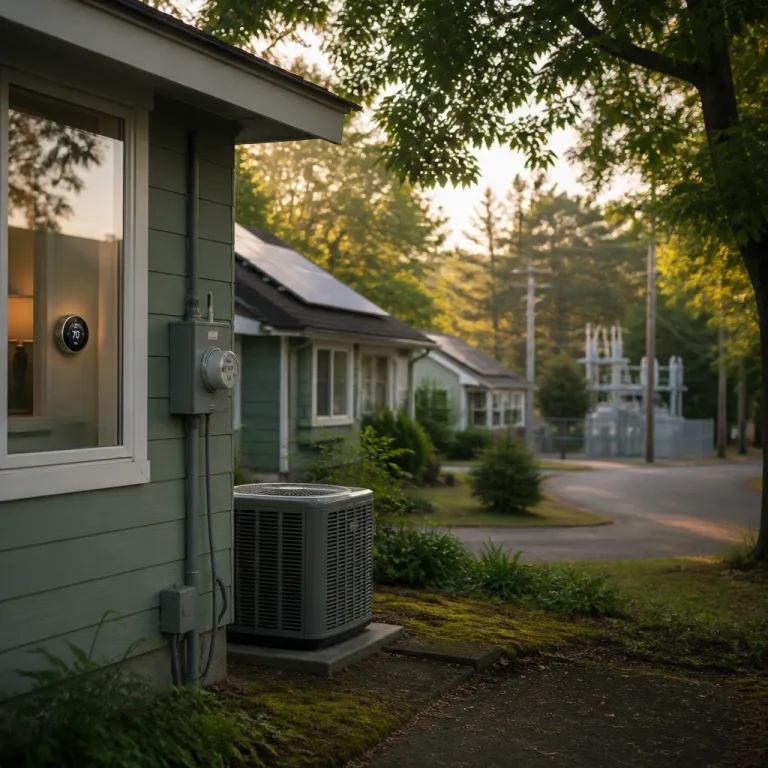
How demand response turns your thermostat into a data sensor
Demand response thermostat privacy data is not an abstract policy issue. When you enroll a smart thermostat in a utility demand response program, you are effectively turning that small wall device into a continuous data sensor for your household. The credits on your bill are tied directly to how much information about your comfort habits, smart devices, and smart HVAC patterns you are willing to trade.
Every smart thermostat that joins these response programs sends granular data back to the cloud, often at intervals of a few minutes rather than hours. That data can include indoor temperature, humidity, setpoints, HVAC runtime, and whether the thermostat thinks the home is occupied, which together create a detailed profile of your daily routine and peak periods of activity. When utilities or third parties talk about grid services and load management, they are often talking about using this stream of data to predict when your home will contribute to peak demand on the grid.
For most customers, the sales pitch focuses on energy savings and bill credits, not on thermostat privacy or data sharing. Yet the same data that lets a smart thermostat pre cool your home before a heat wave also lets utilities and contractors infer when you are away, when you sleep, and how tightly you like to control temperature. In practice, demand response programs can turn smart thermostats into always on monitors that feed virtual power plant platforms and grid services analytics with highly personal data.
Look at how a typical demand response event works to see the trade. During a summer peak demand window, your utility or its third party aggregator sends a signal to your enrolled smart thermostats, asking them to raise the cooling setpoint by 1 to 3 °C or to cycle the HVAC compressor. The smart thermostat then reports back data about how your home actually responded, including whether you overrode the control and how quickly the indoor temperature rose.
That feedback loop is where demand response thermostat privacy data becomes most sensitive. The more precisely a utility can model your home’s thermal behavior and HVAC load, the more value it can extract for grid services and virtual power markets. At the same time, those detailed models can reveal how well insulated your home is, how powerful your HVAC system is, and how your energy use changes during different events and seasons.
Brands like Resideo, Ecobee, and Google Nest all run or integrate with response programs that rely on this kind of continuous data sharing. Resideo Grid Services, for example, partners with utilities to orchestrate fleets of smart thermostats as a flexible load resource during peak periods. Whether you enroll through a utility marketplace, a contractor promotion, or a manufacturer app, the underlying deal is similar ; your thermostat earns credits because your data and your HVAC load become part of a controllable grid asset.
Once you see the thermostat as a sensor, the privacy questions sharpen. Demand response events are not just moments when your setpoint changes ; they are experiments that test how your home behaves under stress, and the results are stored as data points. For an energy conscious homeowner, the key question is not only how much energy you save, but how far you are comfortable letting utilities and third parties peer into your daily patterns.
What your utility actually learns during demand response events
The most important part of demand response thermostat privacy data is the telemetry that flows during and between events. When a utility or its third party aggregator triggers a demand response event, your smart thermostat sends back time stamped data about indoor temperature, setpoints, and HVAC runtime before, during, and after the control period. Over a season, that creates a high resolution picture of how your home and HVAC system respond to heat waves, cold snaps, and peak demand alerts.
Utilities and partners like Virtual Peaker or Resideo Grid Services use this data to estimate your flexible load, which is the portion of your HVAC energy use that can be shifted without breaking comfort guarantees. They can see whether your smart thermostat pre cools or pre heats before peak periods, how quickly your home warms up when the compressor is cycled, and how often you override the control. That information feeds into grid services models that help utilities decide when to call events, how much virtual power they can count on, and whether they need to fire up expensive peaker power plants.
From a privacy standpoint, the issue is not only the data itself but the inferences. A detailed stream of thermostat data can reveal occupancy patterns, such as when the home is empty during workdays or when the family usually goes to bed. It can also show whether you have upgraded to smart HVAC equipment, how aggressively you chase energy savings, and how sensitive you are to temperature changes during response programs. Over time, these patterns can become as identifying as a fingerprint.
Many privacy policies use vague language about data sharing with trusted partners, affiliates, or service providers, without clearly defining which third parties can access your thermostat data. Those policies often reserve the right to update terms periodically, sometimes without prominent notice to customers who enrolled in a utility program years earlier. When you read about what smart thermostats actually collect in detailed explainers such as what data Nest, Ecobee, and your utility actually collect, you start to see how broad those permissions can be.
Opting out of a single demand response event usually stops the utility from changing your setpoint or cycling your HVAC, but it rarely stops data collection. The smart thermostat still logs indoor conditions, runtime, and user interactions, and that data often continues to flow to the manufacturer and any integrated grid services platform. In other words, opting out protects comfort during that event, not necessarily thermostat privacy or long term data sharing.
There is also a technical difference between programs that only adjust setpoints and those that directly control equipment. Setpoint based programs tell the thermostat to raise or lower the target temperature, leaving the thermostat to manage the HVAC load, while direct control programs can cycle compressors or fans through a connected relay or smart HVAC controller. Direct control usually requires deeper integration with contractors or utility systems, which can expand the circle of third parties that touch your data.
Research firms such as Parks Associates have documented how utilities increasingly view smart thermostats and other smart devices as key nodes in residential grid services. That perspective treats your HVAC load as a flexible asset, similar to a small battery or a controllable water heater, and it depends on continuous data sharing to stay accurate. For homeowners, the question is whether the bill credits and energy savings justify letting utilities and their partners learn this much about your daily life.
Choosing between cloud first thermostats and local control alternatives
Demand response thermostat privacy data looks very different if your smart thermostat depends on a cloud account versus running mostly on local control. The mainstream options from Nest, Ecobee, and Resideo are cloud first, which means your thermostat sends data to remote servers even when you are just changing the temperature from the couch. Those platforms make it easy for utilities to plug into response programs, but they also make it harder for customers to limit data sharing with third parties.
A newer class of smart thermostats and smart devices is starting to support local only control using standards such as Matter over Thread or local Wi Fi APIs. In these setups, your phone or smart home hub talks directly to the thermostat on your local network, and cloud access becomes optional rather than mandatory. Some pilot demand response programs are experimenting with using these local channels to send control signals without streaming continuous data back to a central server.
Local control does not automatically solve thermostat privacy, but it changes the default. When the thermostat can operate fully without a cloud account, you can choose whether to enable remote access, voice control, or integration with grid services platforms like Virtual Peaker or Resideo Grid. That choice lets energy conscious customers decide how much of their HVAC load and daily routine they want to expose in exchange for program incentives.
There is also a comfort angle that often gets lost in privacy debates. Cloud first smart thermostats can offer advanced features such as adaptive schedules, occupancy detection, and humidity control, which can genuinely improve comfort and energy efficiency when tuned correctly. Guides that explain features like the thermostat dehumidify setting many homeowners ignore show how these products services can cut cooling load without sacrificing comfort.
Local first thermostats may lag behind on some of those advanced analytics, because they do not constantly upload data for machine learning models. However, they can still participate in simpler demand response programs that use coarse signals, such as a daily peak periods schedule or a manual opt in for specific events. In those cases, the utility sees your participation and approximate load reduction, but it may not receive a full stream of minute by minute thermostat data.
When you compare thermostats, you are really choosing between different data deals. A cloud first smart thermostat that is deeply integrated with grid services can earn higher incentives and deliver more automated savings, but it also sends more data to utilities, contractors, and third parties. A local first device keeps more control and privacy in your hands, at the cost of some automation and potentially lower demand response payments.
For many customers, the right answer is a hybrid approach. Use a smart thermostat that supports both local control and optional cloud features, then selectively enable only the integrations you truly need, such as a single utility program or a trusted smart lighting system like the one described in this guide to smart house lighting control for effortless comfort and energy savings. That way, your HVAC load can still support grid stability during peak demand, while your thermostat privacy settings reflect your actual comfort with data sharing.
Is the data deal worth the credits ? a homeowner checklist
Demand response thermostat privacy data only makes sense when you weigh it against the actual value of the program incentives. Most residential demand response programs pay in the range of 25 to 75 dollars per year for letting the utility adjust your thermostat during peak periods. That is real money, but it is modest compared with the long term value of the detailed data profile that utilities and third parties can build around your HVAC load and daily habits.
Start by mapping what you actually get from the program beyond the headline credit. Some utilities offer higher tier incentives if you enroll multiple smart devices, such as a smart thermostat plus a connected water heater, or if you allow deeper control that cycles equipment rather than just nudging setpoints. Others bundle in extra products services, like free tune ups from approved contractors or bonus bill credits for staying enrolled across multiple seasons.
Next, read the privacy policy and data sharing terms with a skeptical eye. Look for specific language about which third parties can access your thermostat data, how long the utility or aggregator keeps that data, and whether it can be used for marketing or only for grid services and program evaluation. Pay attention to whether the policy allows unilateral updates, because that can change the data deal after you have already installed smart thermostats and joined the program.
Then, consider your own comfort with remote control and automation. If you already rely on smart HVAC controls, smart devices, and app based scheduling, the incremental privacy impact of a demand response program may be smaller, because much of that data is already flowing to the cloud. On the other hand, if you mainly installed a smart thermostat for basic scheduling and energy tracking, enrolling in a program could be the first time your utility gains direct insight into your indoor conditions and HVAC load.
There is also a resilience angle that rarely appears in marketing copy. During extreme weather events, some customers prefer to keep full manual control of their thermostats, even if that means forgoing demand response credits and potential grid services benefits. Others are comfortable letting utilities manage a slice of their HVAC load, as long as they can override control if indoor temperatures drift too far from their comfort zone.
When you run the numbers, remember that the biggest savings usually come from better everyday settings, not from the demand response events themselves. Tightening your cooling setpoint by 1 °C, using humidity control to feel comfortable at slightly higher temperatures, and sealing air leaks can cut far more energy than a handful of peak demand events each summer. The real value of a smart thermostat lies in how it manages your home every day, not just when the utility calls an event.
Ultimately, the data deal is personal. Some customers will gladly trade thermostat data for modest credits and the satisfaction of supporting virtual power plants that reduce the need for new fossil fuel power plants. Others will prioritize thermostat privacy and local control, even if that means paying a little more on the bill to keep their HVAC load and daily routines out of utility analytics dashboards.
Key figures behind demand response thermostat data and privacy
- Residential demand response programs in the United States typically offer bill credits between 25 and 75 dollars per enrolled thermostat per year, which is small compared with the multi year lifespan of the detailed data profiles created from continuous thermostat telemetry.
- Studies from Parks Associates have reported that millions of U.S. households now own smart thermostats, and a significant share of those devices are eligible for utility demand response programs, turning residential HVAC load into a major component of emerging virtual power plant strategies.
- Industry analyses of grid services portfolios show that flexible residential loads, including smart HVAC systems controlled through smart thermostats, can reduce peak demand enough to defer or avoid the construction of new peaker power plants in some regions, which is a key driver behind aggressive utility recruitment of customers into response programs.
- Privacy reviews of smart thermostat ecosystems have found that many manufacturers and utilities reserve broad rights to share thermostat data with third parties and affiliates, with policy updates that may occur without prominent notice, underscoring the need for homeowners to periodically recheck thermostat privacy terms after enrolling in any program.
References
- Federal Energy Regulatory Commission (FERC) reports on demand response and advanced metering.
- Parks Associates research on smart thermostats, utilities, and residential demand response.
- U.S. Department of Energy resources on grid interactive efficient buildings and virtual power plants.