
Summary
Editor's rating
Value for money: good, but depends on your setup
Design: simple, white, and a bit chunky but fine
Battery life and everyday hassle factor
Build quality and long-term feel
Performance: does it actually heat better?
What you actually get in the box
Pros
- Local control with Matter over Thread, no cloud account or subscription needed
- Works with Apple Home, Alexa, Google Home, and Home Assistant from the same hardware
- Pretty accurate temperature control with useful scheduling and open-window detection
Cons
- Requires a compatible Thread Border Router, which adds hidden cost if you don’t have one
- Motor is audible in quiet rooms, which can bother light sleepers
- Price is higher than basic programmable or some Wi‑Fi radiator valves

Specifications
View full product page →| Brand | Eve |
Smart heating without the drama?
I’ve been slowly turning my flat into a smart home, but heating was still stuck in the stone age with manual radiator knobs. I picked up this Eve Thermo (Matter, 5th gen.) 2-pack to see if I could finally stop running around adjusting radiators every morning and night. I’ve used it for a bit now on two radiators: bedroom and living room, both on standard thermostatic valves.
For context, I already have an Apple TV 4K as a hub and a bunch of HomeKit stuff, plus some Alexa speakers. That made this kit interesting because it supports Matter over Thread, so in theory it should work with Apple, Alexa, and Google all from the same devices. No extra bridge, no weird proprietary app lock-in. On paper, it sounds tidy.
In practice, it’s mostly like that: local control, no cloud login, and it does what a smart TRV is supposed to do – set schedules, adjust temperature remotely, and avoid heating when windows are open. But it’s not magic. You still need a compatible Thread border router, you still have to fiddle a bit with pairing, and the physical noise of the valve motor is noticeable in a quiet room.
If you’re expecting some kind of futuristic perfect heating robot, you’ll be disappointed. If you just want to make your radiators a bit smarter without relying on a cloud service, this is a pretty solid option, especially if you’re already in the Apple or Home Assistant world. I’ll break down what worked well for me, and what felt a bit meh for the price.
Value for money: good, but depends on your setup
Let’s talk price and value. Eve is not the cheapest brand out there, and this 2-pack sits in the mid-to-high range of smart TRVs. If you just want simple programmable heating and don’t care about smart home integration, you can find cheaper digital radiator valves that do basic scheduling without any app or voice control. So you’re clearly paying extra here for Matter, Thread, and multi-ecosystem support, plus the privacy angle (no cloud, no account).
For me, the value felt decent because I already had an Apple TV 4K and a mixed ecosystem with Alexa speakers. Being able to control the same valves from Siri on my phone and from an Echo in the kitchen, without extra bridges, is genuinely practical. If you’re deep into smart home stuff and want everything local and interoperable, these valves fit nicely into that picture. In that case, the price is easier to swallow.
If you’re starting from scratch and don’t own any Thread Border Router, it’s a bit different. You’ll need an Apple TV, HomePod mini, supported Echo, Nest Hub, or Home Assistant box, which adds a big hidden cost. In that scenario, cheaper Wi‑Fi based TRVs with their own bridges might make more sense financially, even if they are less clean technically. Same if you only want one or two radiators controlled and don’t care about future-proof protocols.
Overall, I’d say the value is pretty solid for tech‑oriented users who care about privacy and standards, and more “meh but it works” if you just want basic remote control and scheduling. You’re paying for the ecosystem friendliness and the lack of subscription, not for fancy looks or ultra-advanced heating analytics. If that’s what you’re after, the price is justified. If not, there are cheaper ways to make your radiators a bit smarter.
Design: simple, white, and a bit chunky but fine
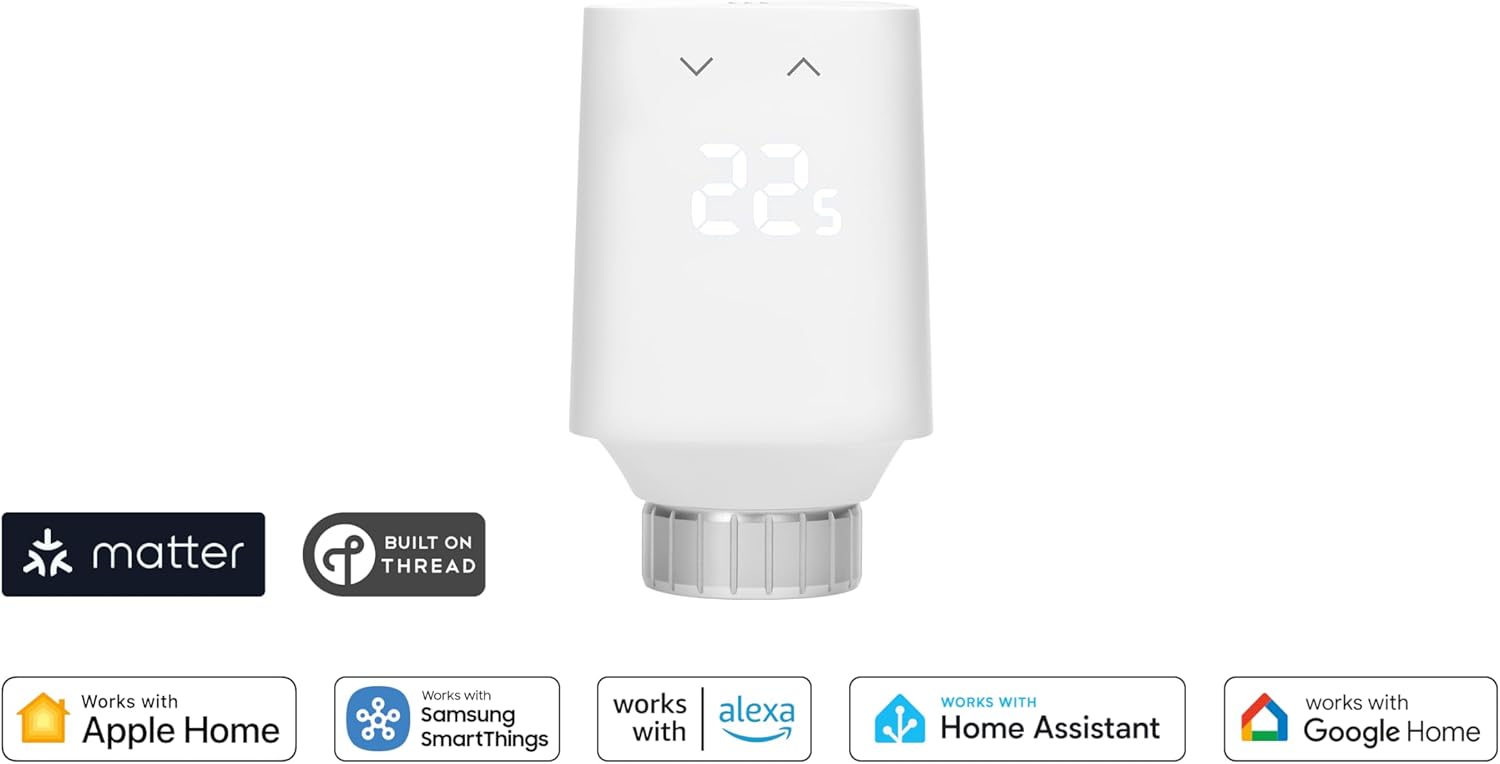
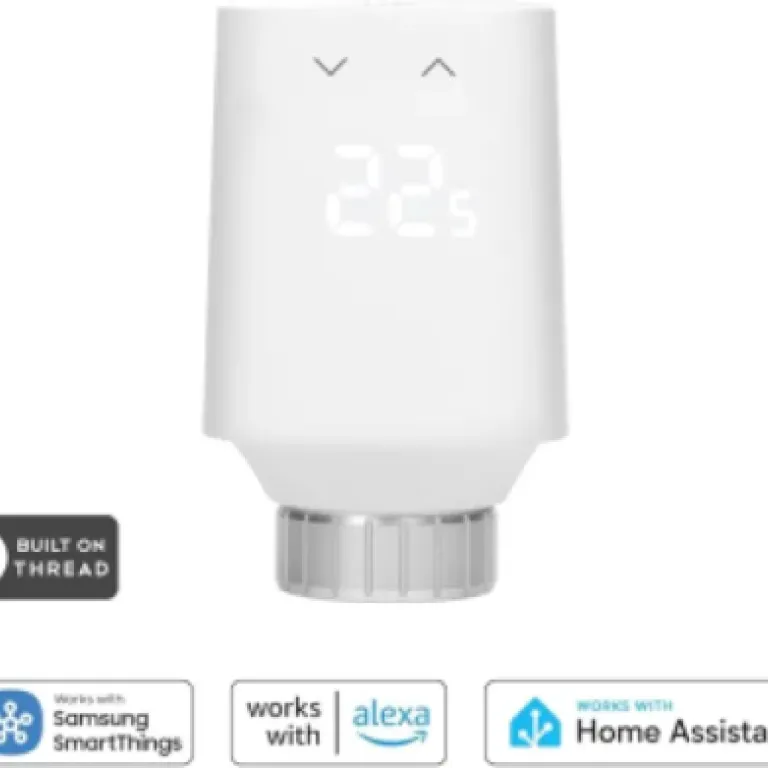
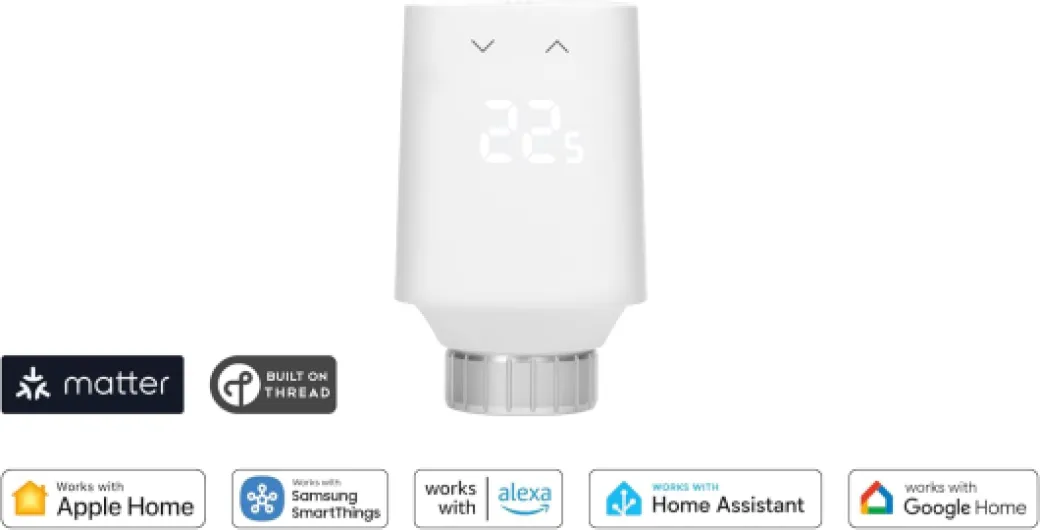
The design is pretty no-nonsense. Both valves are white plastic cylinders with a small front display and touch controls on the side. If you’re used to the look of classic Danfoss or generic TRV heads, this is basically those, just with a screen and some brains. No metal, no fancy finishes, just functional plastic. It doesn’t scream premium, but it also doesn’t look cheap or toy-like once installed.
The display is small but readable. It shows the target temperature and a few icons depending on the mode. It’s not a high-end screen, but you can easily see the numbers from across a small room. The touch controls are just two capacitive areas to raise or lower the set temperature. They work, but they’re not super tactile, so you sometimes need to look closely to see if your tap registered. If you want a big, obvious dial like on some Tado or Netatmo heads, this is more minimal.
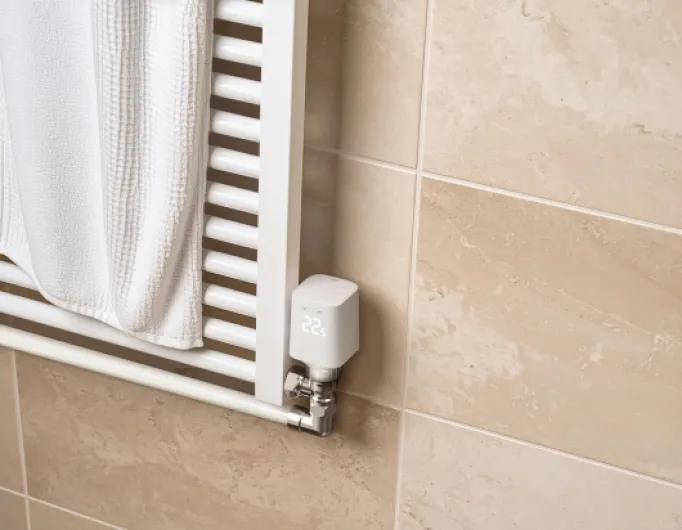
On the radiator, the valves sit horizontally and don’t take up much extra space. They’re a bit longer than my old mechanical heads, so on one radiator under a sill it’s a tighter fit, but still okay. The design is clearly aimed at blending into a typical white radiator environment, not making a style statement. In a modern white room, they just disappear, which I like. In a more classic or dark interior, they’ll stand out a bit more as white plastic lumps.
One thing to note: the motor noise is noticeable. When the valve adjusts, you hear a short mechanical whirr. It’s not crazy loud, but in a totally quiet bedroom at night you’ll definitely hear it. Personally I got used to it after a few days, but if you’re very sensitive to noise, that’s worth keeping in mind. Overall, the design is practical and neutral: it gets the job done, doesn’t look silly, but it’s not especially stylish either.
Battery life and everyday hassle factor
Battery is always a worry with smart radiator valves because they’re moving a physical mechanism, not just sending signals. The Eve Thermo uses AA batteries (two per valve, included). I haven’t run them for a full season yet, but based on typical TRV behavior and Eve’s usual claims, you’re looking at several months to maybe a year depending on how often the valve moves and how much you play with the temperature.
What I liked is that you’re not locked into some proprietary pack. If a valve dies in the middle of winter, you just swap AAs and you’re done. No hunting for a cable, no weird connector, no waiting for a recharge. In daily use over the test period, the battery level didn’t move much in the app, which is reassuring. Of course, that’s early days, but at least it doesn’t burn through batteries in a week.
One thing to keep in mind: more automation = more valve movement = shorter battery life. If you set very aggressive schedules with constant temperature changes, the motor will work more often. Same if your heating system cycles a lot. If you want to stretch battery life, it probably makes sense to keep a few stable temperature zones instead of micro-managing every hour.
The only small downside is that you do have to remember that these are battery devices stuck to your radiators. If a battery dies when you’re away and you rely only on remote control, that radiator becomes dumb again until you replace them. Personally, I’m okay with checking battery status at the start of winter and swapping them proactively. For what it’s worth, the combination of Thread + battery is nice: you don’t have to worry about Wi‑Fi signal at the radiator, and you avoid another power brick or cable hanging around.

Build quality and long-term feel
The valves are made in China, like most smart home gear, and the overall build feels decent. The plastic shell doesn’t flex or creak when you tighten it onto the valve, and the mounting thread felt solid enough. I installed and reinstalled one of them twice while playing with adapters, and nothing stripped or cracked. So from a mechanical point of view, it seems fine for normal home use.
Internally, you can hear the motor and gearing when it moves. It sounds like a typical small stepper motor – not high-end, not junk. If you’ve used other smart TRVs (Tado, Eurotronic, etc.), it’s in the same ballpark. I didn’t notice any grinding or weird noises even after a bunch of manual adjustments while testing. I don’t expect this to be something you replace every year unless your heating system is doing something very odd.
Where durability is harder to judge is the electronics and firmware. The good part is that everything runs locally via Thread and Matter, so you’re not depending on some random cloud server that could get shut down. As long as Matter and Thread are supported by Apple/Amazon/Google/Home Assistant, these should keep working. Firmware updates are usually delivered through the Eve app, and historically Eve has been decent at supporting products for several years.
The only potential concern is the moving parts + heat + occasional condensation combo. These things live on hot metal pipes, occasionally near windows, so they see some temperature swings. That’s the same for all TRVs though. Physically, nothing about the Eve Thermo feels fragile. It’s not built like a tank, but for a plastic smart valve, it’s solid enough. If you treat it like a normal radiator head and don’t kick it or use it as a handle, it should hold up fine over multiple seasons.
Performance: does it actually heat better?
In terms of pure performance, the main thing I looked at was: does the room reach and stay near the target temperature without constant fiddling? On that front, the Eve Thermo does a pretty solid job. Once calibrated, my living room stayed within about 0.5–1°C of the set temperature according to a separate thermometer I placed on a shelf. It’s not laboratory precise, but it’s more than good enough for normal use.
The Heating Intelligence and scheduling are where it becomes actually useful. I set up time-based schedules in the app: warmer in the morning and evening, cooler during the day and at night. After a few days, it felt like I didn’t have to think about it anymore. You can also use presence-based rules (home/away) through your smart home platform. In practice, my radiators stopped blasting heat when nobody was home, which should save some energy, even if I didn’t measure exact kWh savings.
Another nice touch is the open-window detection. When I opened the window in the bedroom to air the room, the valve cut the heating after a short temperature drop, then resumed later. It’s not perfect – sometimes it took a bit longer to react – but it clearly avoided the classic situation where you’re heating the street for 15 minutes. For a battery-powered TRV, that’s already a decent level of automation.
Responsiveness via app and voice was good thanks to Thread. Changes from the Apple Home app applied in a few seconds, and Siri/Alexa commands like “set the bedroom to 19 degrees” worked reliably. I had one short moment where one valve showed as unreachable, but it came back on its own after a minute. Overall, performance is solid: not mind-blowing, but clearly better than dumb valves and without the random lag you sometimes get with Wi‑Fi devices on weak networks.
What you actually get in the box
Out of the box, the Eve Thermo 2-pack is pretty straightforward. You get two valves, four AA batteries already included, an adapter set, a mounting screw, and a very short quick start guide. No fancy extras, but everything you need to install on most standard radiator valves seems to be there. I used the included adapters on one older radiator and it fit fine after a bit of trial and error.
The valves themselves are compact: around 5.5 x 8.9 x 5.5 cm. They’re a bit chunkier than a dumb plastic TRV head, but nothing ridiculous. They run on AA batteries, which I prefer over some weird proprietary rechargeable pack. If a battery dies in winter, I can just grab new AAs from a drawer instead of hunting for a cable and waiting.
Setup-wise, you absolutely need a Thread Border Router from one of the supported ecosystems. I used an Apple TV 4K (2nd gen) and pairing through the Apple Home app was mostly painless: scan the Matter code, wait 30–60 seconds, done. I also tested voice control through Alexa afterwards using the same Matter setup, which worked without extra bridges. That’s the main selling point: one device, multiple ecosystems, no Eve cloud account.
The product pitch is pretty clear: local control, privacy, and compatibility. No subscription, no Eve cloud, no analytics dashboard trying to upsell you. If you hate creating yet another account for every gadget, this is a big plus. But the flip side is: if you’re not comfortable with smart home hubs and protocols like Thread and Matter, the initial setup might feel a bit technical. It’s not rocket science, but it’s not as plug-and-play as a Wi‑Fi thermostat with its own app either.
Pros
- Local control with Matter over Thread, no cloud account or subscription needed
- Works with Apple Home, Alexa, Google Home, and Home Assistant from the same hardware
- Pretty accurate temperature control with useful scheduling and open-window detection
Cons
- Requires a compatible Thread Border Router, which adds hidden cost if you don’t have one
- Motor is audible in quiet rooms, which can bother light sleepers
- Price is higher than basic programmable or some Wi‑Fi radiator valves
Conclusion
Editor's rating
The Eve Thermo (Matter, 5th gen.) 2-pack is a solid choice if you already live in the Apple, Alexa, Google, or Home Assistant world and you care about local control and privacy. It does the basics well: it keeps rooms close to the temperature you set, handles schedules, reacts reasonably to open windows, and responds quickly to app and voice commands thanks to Thread. The fact that it doesn’t need a cloud account or subscription is a real plus if you’re tired of signing up for every small gadget.
It’s not perfect though. The motor noise is audible in quiet rooms, the touch controls are a bit basic, and the price is on the higher side compared to simpler programmable valves or some Wi‑Fi TRVs. Also, if you don’t already own a compatible Thread Border Router, the real cost gets higher quickly. So this is not the best option for someone who just wants cheap, simple temperature control without caring about smart home integration.
If you’re a bit of a tech person, already have a supported hub, and want radiator valves that will work across platforms and stay usable even if some cloud service disappears, these make sense. If you just want to spend as little as possible to stop freezing in the morning, you can find more basic gear for less. Overall, I’d say it’s a good product for smart home users, decent but not mind-blowing for everyone else.