
Summary
Editor's rating
Value for money: good if you’re already in the Hive ecosystem
Design: simple square box, clear enough screen
Battery life and power: better than older Hive versions
Build quality and durability: feels okay, but mostly plastic
Performance: heating control, geolocation and daily use
What you actually get and how it works day to day
Pros
- Reliable heating control with flexible daily schedules and a handy boost function
- Works well as a like‑for‑like replacement for existing Hive setups, easy pairing
- Good battery life on the newer model and no ongoing subscription required for core features
Cons
- Interface on the thermostat is a bit clunky for setting full schedules without the app
- Mostly plastic build and not very premium in look or feel
- Less attractive value if you don’t already own a Hive Hub and need to buy into the ecosystem separately

Specifications
View full product page →| Brand | Hive |
A simple way to make your boiler a bit smarter
I’ve been using Hive for heating for a while, and this "Active Heating without Hive Hub" thermostat is basically the bit you buy when your old Hive thermostat dies or you move into a place that already has the Hive receiver wired in. I got it because the thermostat in my hallway was wrecked when we moved in, and I didn’t want to pay for a full new kit or subscription. So this is just the thermostat and receiver, no hub, no extras. If you already live in a house with Hive fitted, this is the kind of replacement that makes sense.
In day-to-day use, the main thing I noticed is how quickly I forgot about it, which is actually a good sign for this type of product. You pair it once, set your schedule through the thermostat or app (if you already have a Hive Hub from before), and then it just runs the heating. No monthly fees, no weird pop‑ups trying to upsell anything. It’s more like a regular programmable thermostat that happens to be a bit smarter and a lot easier to tweak.
Compared to older dumb thermostats I’ve had, the big difference here is the boost, holiday mode, and geolocation alerts. You don’t think you’ll use them much, but in practice you do. For example, I’ve used boost a lot when we’ve come home earlier than planned, and it’s nice to hit a button instead of messing with the whole schedule. The geolocation alerts are handy but not perfect – sometimes it nags a bit when I’m just popping to the shop nearby.
Overall, my first impression after a couple of weeks is that it’s a practical, no‑nonsense upgrade if you’re already in the Hive ecosystem or replacing a broken Hive thermostat. It’s not some futuristic smart home brain; it’s basically a cleaner, more flexible thermostat that’s easy enough to live with. There are some annoyances and it’s not the cheapest thing on the market, but it gets the basics right: schedules, manual control, and not draining batteries every few days like some older units apparently did.
Value for money: good if you’re already in the Hive ecosystem
On the value side, this thermostat plus receiver combo sits in that mid‑range zone. It’s not the cheapest programmable thermostat you can buy, but it’s also not in the top price bracket with some of the fancier smart systems. Where it makes the most sense is if you already have Hive in your house, or you’ve moved into a place with a Hive receiver wired in, and you just need to replace the thermostat. In that scenario, the value is good: you avoid paying for a full kit, installation, or a new ecosystem, and you’re up and running in under an hour.
If you’re starting from scratch and don’t own a Hive Hub, this particular "without Hive Hub" version is a bit less interesting. You’ll still get a decent programmable thermostat with wireless control to the receiver, but you’ll miss out on the app, remote control, and geolocation unless you buy a hub separately. At that point, you might want to compare it with other brands like Nest, Tado, or even simpler programmable thermostats that cost less but don’t have the smart features. It really depends on whether you care about phone control and smart features or you just want timed heating.
What I like is that there are no ongoing subscription costs for the core features. You can run schedules, boost, holiday mode, and frost protection without paying monthly fees. Some companies like to lock things behind subscriptions now, so it’s good that Hive’s basic heating control doesn’t do that. You pay once, you get the features. The only extra cost over time is battery replacement and, obviously, your gas bill.
Considering the Amazon rating around 4.6/5 and the general feedback from users who have upgraded from older Hive models, I’d say the value for money is solid but not mind‑blowing. If you’re already invested in Hive, it’s an easy choice and feels like money well spent. If you’re not, you should compare it carefully to other smart thermostats and decide whether the Hive ecosystem suits you. For my use case – replacing a damaged hallway thermostat in a house that already had Hive – it made financial sense and did what I needed without extra fuss.
Design: simple square box, clear enough screen
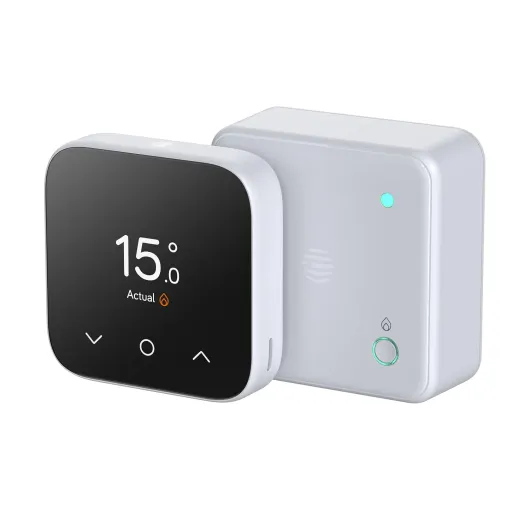
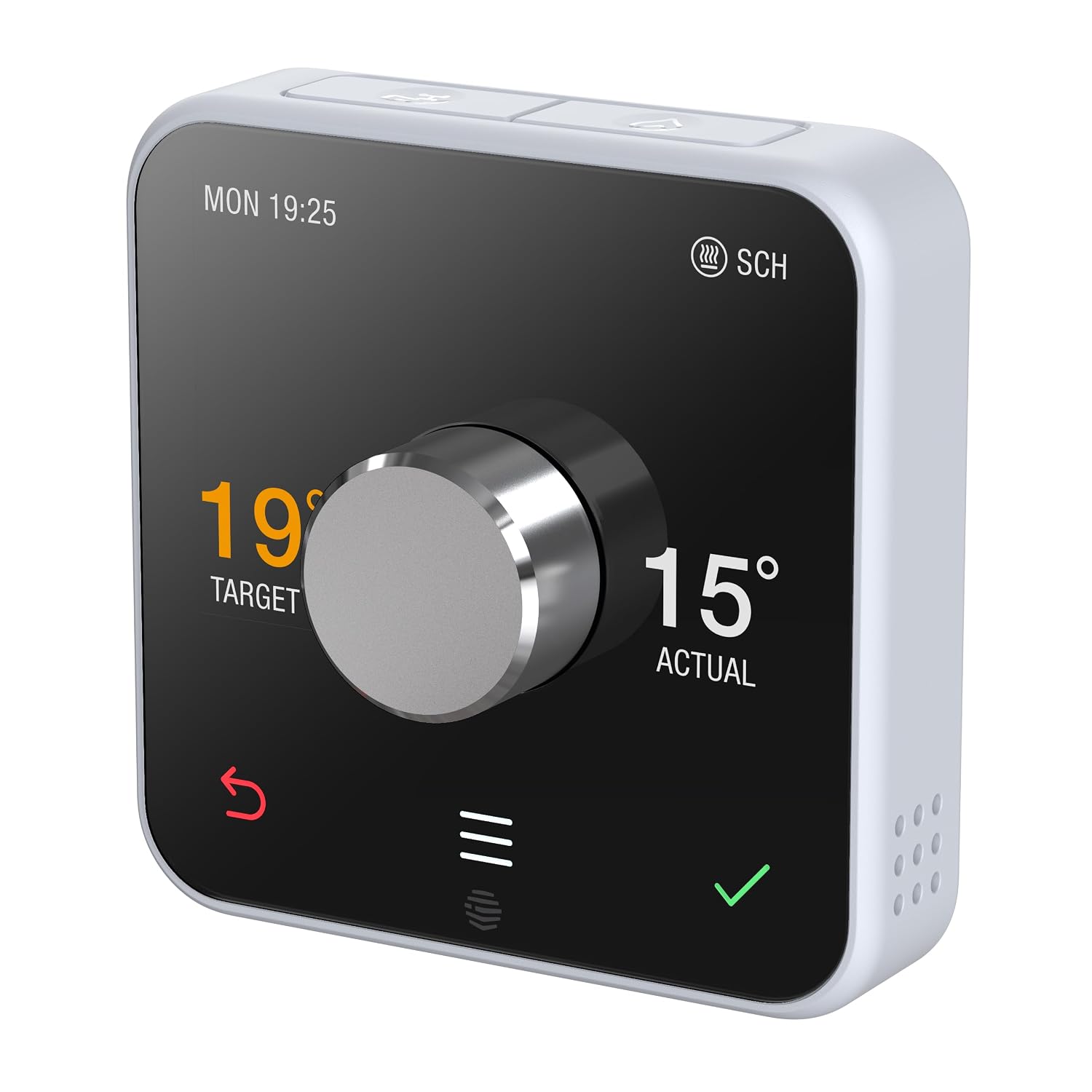
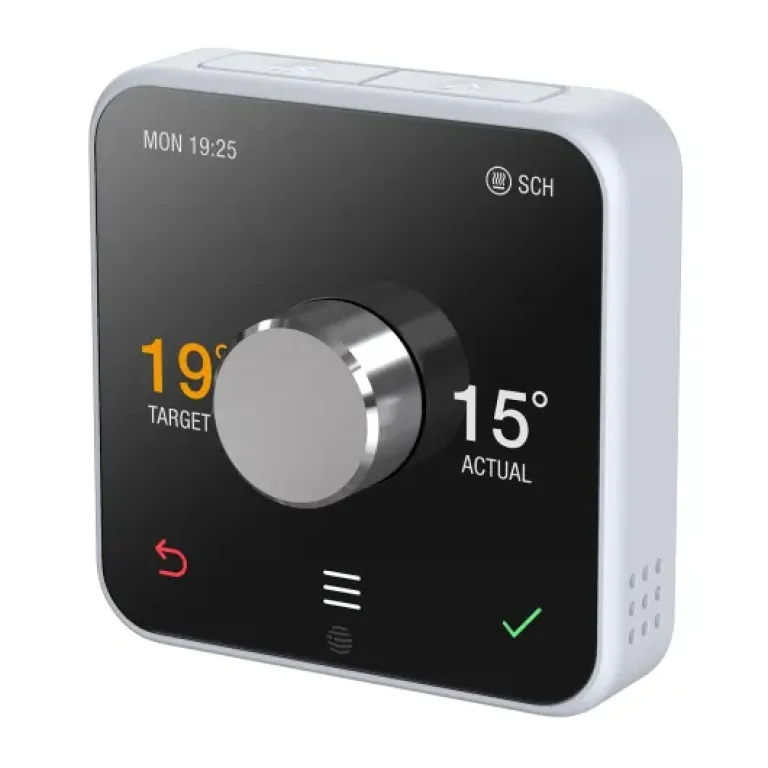
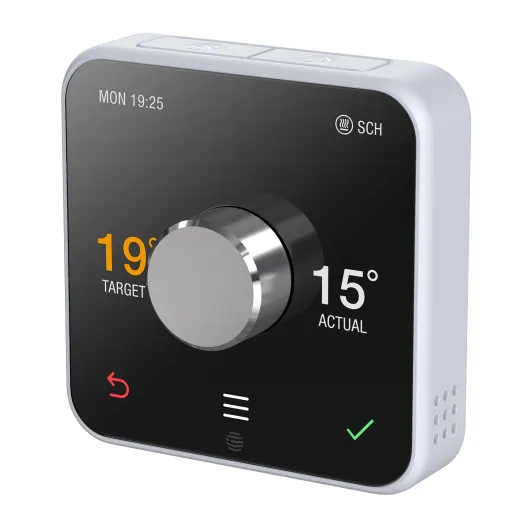
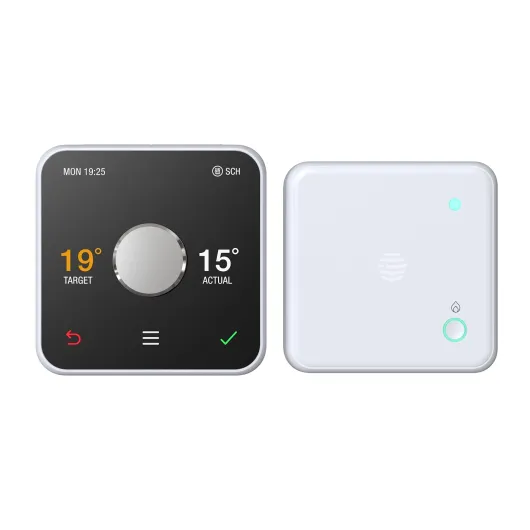
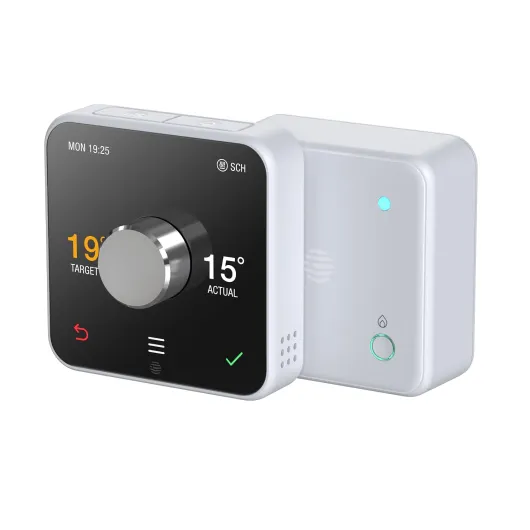
Design-wise, it’s a plain white square with a polished plastic finish and a central display. It’s not something you’ll stare at for fun, but it doesn’t look cheap or out of place either. On the wall, it kind of disappears, which I actually like for a thermostat. I’d rather it blend into the hallway than try to be some flashy gadget. The dimensions are compact enough that it doesn’t dominate the wall, and the square shape feels modern but not over the top.
The screen is backlit and readable, even in a dim hallway. You get the current temperature, the target temperature, and basic icons for heating status and modes. It’s LCD/LED style, nothing fancy, but functional. You’re not going to get high‑resolution graphics or colourful widgets here, and honestly that’s fine. The most important thing is that you can quickly see if the heating is on and what temperature it’s set to. In that sense, it does the job. The only minor annoyance is that some of the smaller icons and text might be a bit small for older eyes if the thermostat is mounted high.
The control layout is a mix of push buttons and a touchpad style interface. You basically have physical buttons that you push to move around menus and change temperature. After a couple of days, muscle memory kicks in and it’s easy enough, but the menus aren’t totally intuitive the first time around. For example, setting up a full weekly schedule on the device itself is doable but a bit tedious if you’re not patient. It’s much nicer to do that part via the app if you have the hub, then just use the thermostat for quick tweaks.
One design feature I actually like is that the thermostat can be removed from its wall cradle and moved around the house. In practice, I’ve done this a few times when working from a cold room; you can bring the thermostat to where you are and let it measure the temperature there instead of in the hallway. It’s a simple thing, but it makes the heating feel more relevant to where you spend time. Overall, the design isn’t exciting, but it’s practical, discreet, and easy enough to live with. If you want something that looks flashy on the wall, this isn’t it, but as a tool, it’s fine.
Battery life and power: better than older Hive versions
The thermostat runs on 4 x AA lithium batteries, which are included in the box. This is where older Hive models had some issues, especially the Series 2 units that some people reported were chewing through batteries in a matter of weeks or even days when they started to fail. In my case, this newer model (often referred to as Series 3) has behaved much better. After several weeks of use, the battery indicator hasn’t budged, and based on other users’ feedback, you’re generally looking at months of battery life, not days.
Having it battery powered has pros and cons. On the plus side, it means you can put the thermostat where it makes sense for temperature, not just where there’s a cable coming out of the wall. It also makes swapping it out or moving it straightforward. On the downside, you do have to remember that at some point the batteries will die, and if you ignore the low battery warning, your heating control will stop responding. For a critical device like heating, that’s something to keep in mind. I’d recommend keeping spare AA lithium batteries in a drawer so you’re not stuck on a cold Sunday night.
Compared to wired thermostats I’ve used before, the only real practical difference is that you occasionally unscrew the battery cover and swap cells. The device is light (around 172 grams), so there’s no sense of weight or sturdiness to fall back on, but once it’s in the cradle on the wall you don’t really think about that. I haven’t noticed any performance drops as the batteries age so far; no random disconnects or lag in turning the boiler on and off, which is more than I can say for some wireless units from other brands.
Overall, I’d say the battery situation is decent: not perfect, but fine. It’s definitely an improvement over the older models that some people complained about. If you’re upgrading from a Series 1 or 2 that ate batteries, this one should feel like a relief. Just accept that once or twice a year you’ll have to spend a few quid on batteries, and you’re good. For the flexibility you get from a wireless thermostat, that trade‑off feels reasonable to me.
Build quality and durability: feels okay, but mostly plastic
The thermostat is mostly plastic, with a polished finish. In the hand, it doesn’t feel premium, but it doesn’t feel flimsy either. It’s light, which is normal for a battery‑powered device. The buttons have a decent click and haven’t shown any signs of sticking or mis‑pressing so far. For something that sits on a wall and gets a few presses a day, I’d say the physical build is acceptable. You’re not going to be throwing this around or stuffing it in a bag, so it doesn’t need to be built like a tank.
In terms of long‑term durability, Hive as a brand seems to have a mixed history. Earlier versions had that battery drain issue that basically signalled the unit was on its way out. One of the Amazon reviewers mentioned their Series 2 unit started eating batteries every few days after several years, and they ended up replacing it with this newer version. So far, on this model, I haven’t had anything like that. No random resets, no frozen screen, no weird behaviour. If it follows the same pattern as mine and others, you’re looking at several years of normal use before any problems show up, if they do.
The receiver, which is the bit that actually connects to your boiler, tends to just sit there and work. Mine was already installed when we moved in, and it’s still going fine. The relay click is clear when it turns the boiler on and off, and there’s no burning smell or overheating or anything like that. It’s mounted near the boiler, out of the way, which is where it should be. I haven’t opened it up, but from the outside, the casing feels solid and properly screwed together.
Overall, I’d rate the durability as pretty solid for the price range. It’s not built like high‑end industrial kit, but for a home thermostat it’s okay. If you want something that will definitely last a decade, you might look at higher‑end systems, but for a normal semi‑detached or flat, this feels fine. Just be aware that if you start to see weird battery behaviour after a few years, it might be time to think about replacing the thermostat, as that seems to be the common failure pattern on older Hive units.
Performance: heating control, geolocation and daily use
In terms of performance, the main question is: does it control the heating reliably and keep the house at a reasonable temperature? In my experience, yes, it does, as long as your receiver and thermostat are properly paired and you’re within a normal range of distance. The thermostat talks to the receiver over radio, and I haven’t had any dropouts or strange behaviour so far. When the room temperature drops below the set point, the boiler kicks in; when it goes above, it shuts off. It sounds obvious, but some cheaper thermostats hunt up and down or overshoot a lot. This one is reasonably stable.
The heating schedules are flexible enough for most people. Six slots per day means you can fine‑tune morning, daytime, evening, and night temperatures. For example, I run it at 20°C in the morning, 17°C during work hours, 20.5°C in the evening, and 16°C at night. Once set, the schedule just runs, and I barely touch it. When plans change, I tend to use the boost button or adjust the target temperature temporarily instead of reprogramming the whole thing. The fact it supports multizone setups (if you have more than one thermostat/receiver combo) is good, although I only use it for a single zone with a combi boiler.
The geolocation alerts are a nice extra if you have the hub and app. You get notifications when you leave a certain radius from home and the heating is still on, or when you’re heading back and the heating is off. In real life, it’s a bit hit‑and‑miss in terms of usefulness. It works, but sometimes it reminds you when you’re only doing a quick trip, and after a while I found myself ignoring some alerts. Still, on days when we went away for a weekend and forgot to switch to holiday mode, the alert saved wasting gas, so I can’t complain too much.
Other performance features like Automatic Frost Protection and child lock are more “set and forget”. Frost protection is reassuring if your boiler is in a cold space or you go away in winter; it basically stops the system from letting pipes freeze by running the boiler if the temperature drops too low. I haven’t had a freeze situation to test it, which is good news in itself. The child lock is handy if you’ve got kids who like pressing buttons, since you can pin‑lock the thermostat or app. Overall, performance is solid rather than exciting: it heats when it should, saves a bit of hassle, and doesn’t do anything weird. That’s what you want from a thermostat.
What you actually get and how it works day to day
Out of the box, you get the square thermostat, the receiver, four AA lithium batteries, and the paper guides. No hub in this version, so if you don’t already own a Hive Hub you’re not going to get the full app control or any smart integrations. That’s the first thing to be clear about: this is best for people who already have Hive installed or are just after a simple programmable thermostat plus receiver, not a whole smart home setup from scratch.
The thermostat itself runs on batteries and talks wirelessly to the receiver, which is usually mounted near your boiler. In my case, the receiver was already there, so I only had to pair the new thermostat. The pairing process is straightforward if you follow the steps properly: press buttons on the receiver, then on the thermostat, wait for the signal icon to behave as described in the guide. It took me under 15 minutes start to finish, including re‑mounting it in the hallway. If you’re replacing an older Hive (Series 1 or 2), it’s basically a like‑for‑like swap with a bit of menu fiddling.
In everyday use, you control it in three main ways: schedule, manual set temperature, and boost. The schedule lets you set up to six time slots per day, so you can do the classic morning heat‑up, daytime setback, evening comfort, and so on. It’s not rocket science, but it’s enough for most homes. Boost is handy when you’re cold and don’t want to think; you just hit boost for 30 minutes up to several hours and it runs the heating regardless of the schedule. There’s also a holiday mode that keeps the house at a basic level while you’re away.
One thing I appreciate is that there’s no subscription nonsense baked into the thermostat itself. The device does what a thermostat should do: turn the heating on and off based on temperature and time. If you already have the Hive app and hub, you get extras like geolocation alerts and remote control, but the thermostat on its own is still fully usable. For me, that’s the right balance: smart features if you want them, but it still works fine as a stand‑alone heating controller if the app or Wi‑Fi has a bad day.
Pros
- Reliable heating control with flexible daily schedules and a handy boost function
- Works well as a like‑for‑like replacement for existing Hive setups, easy pairing
- Good battery life on the newer model and no ongoing subscription required for core features
Cons
- Interface on the thermostat is a bit clunky for setting full schedules without the app
- Mostly plastic build and not very premium in look or feel
- Less attractive value if you don’t already own a Hive Hub and need to buy into the ecosystem separately
Conclusion
Editor's rating
Overall, the Hive Thermostat for Heating control (Combi Boiler and Multizone) without Hive Hub is a practical, no‑nonsense option if you’re already in the Hive world or moving into a house that has Hive hardware installed. It handles the basics well: reliable heating control, flexible schedules, boost, holiday mode, and frost protection. The battery life on this newer model seems much better than some of the older units that had battery drain issues, and the wireless link to the receiver has been stable in everyday use. The design is simple, the screen is readable, and being able to take the thermostat off the wall and move it around the house is genuinely useful.
It’s not perfect. The interface on the device itself could be clearer, and setting complex schedules directly on the thermostat is a bit of a slog compared to doing it in the app. The plastic build is fine but nothing special, and if you don’t already own a Hive Hub, this particular version is less attractive because you’re missing the full smart features unless you buy extra hardware. Also, there are cheaper thermostats out there if all you want is basic on/off with a timer. But if you want a solid mid‑range smart thermostat that works well with combi boilers and can handle multizone setups, this Hive unit is a sensible choice. I’d recommend it mainly to people who already have Hive installed or who value the mix of app control, no subscription, and straightforward daily use.