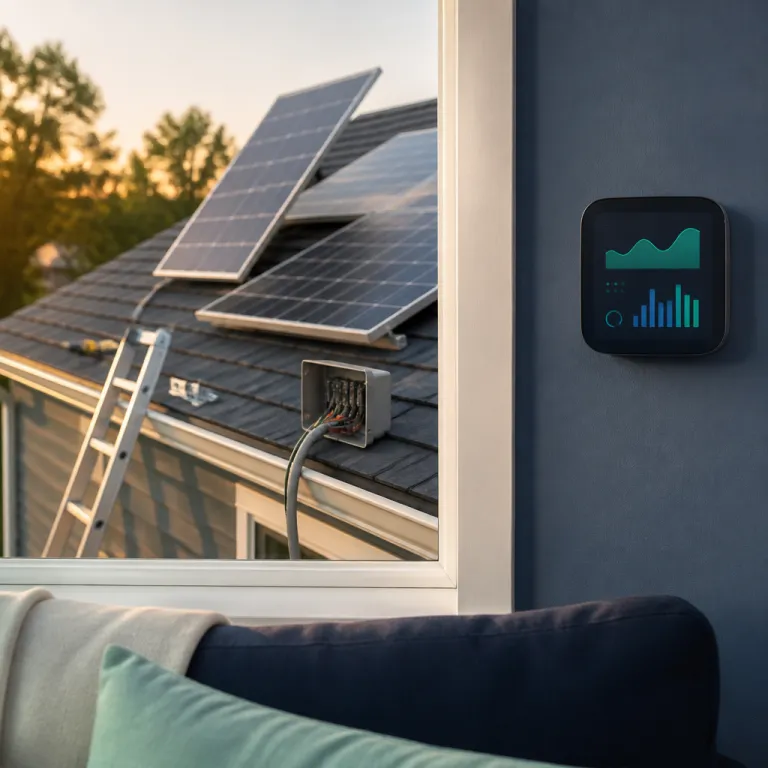
Enphase IQ Air thermostat turns solar data into HVAC decisions
The Enphase IQ Air thermostat arrives as a smart thermostat built first for energy decisions, not just temperature tweaks. Enphase Energy has opened pre-orders for IQ Air, targeting homes where solar production, battery storage, and HVAC systems already form a connected energy system. For a smart home enthusiast in the United States, this is one of the first solar-integrated smart thermostats that treats your rooftop array like a live solar power plant rather than a background accessory, while also raising early questions about IQ Air price and long-term value.
At the center of the device is an HD color power display that shows real-time solar production, home power loading, and battery state of charge in a single glance. According to Enphase’s IQ Air product overview and preliminary spec sheet, the thermostat can shift air conditioning and other HVAC loads based on time-of-use rates, weather forecasts, solar battery capacity, and virtual power plant events signaled by utilities. That means the Enphase IQ Air thermostat can pre-cool or pre-heat using surplus solar energy, then ease off when grid prices spike or when a demand response event asks your home to behave like a tiny virtual power resource.
Unlike most Wi‑Fi smart thermostat models that only see indoor temperature and maybe outdoor air data, IQ Air is wired into the full Enphase system. When paired with an Enphase Energy solar battery, the thermostat can prioritize comfort while still preserving enough battery power for evening peaks or outages. For homeowners already using the Enphase app to track solar batteries and solar production, IQ Air becomes another screen in the same platform rather than yet another standalone device to sign into and manage, and that deeper Enphase thermostat compatibility is central to how the product is positioned.
The company positions IQ Air as a control surface for the broader Enphase Energy system, not just a wall gadget. In practice, that means the thermostat can respond to live solar data, production and battery status, and grid signals without you touching a schedule. For households that already treat their roof as a personal power plant, this thermostat finally lets the HVAC system speak the same energy language as the inverters and storage, while also making the home feel more like a coordinated energy hub than a collection of disconnected devices.
From a buying perspective, Enphase has kept the offer simple, but the IQ Air price will still matter for many households. The company has not announced aggressive discount services or bundles yet, so shoppers will need to weigh the cost of IQ Air against established smart thermostat competitors that lack deep solar integration. For readers comparing touchscreens and automation features, a broader look at top touchscreen programmable thermostats on Smart Thermostat Guru can help frame where IQ Air fits in the market and whether its solar-aware features justify a premium over more generic models.
Pre orders, installation, and the walled garden question
Enphase opened IQ Air pre-orders through its own online platform, where you can add the thermostat to your cart alongside microinverters, solar batteries, and other hardware. The buying flow mirrors a typical e‑commerce experience, but with energy gear instead of headphones, and you can add cart items that build out a full home energy system. For now, pre-orders are focused on existing Enphase solar owners, which signals that the company sees IQ Air as an accessory for its installed base rather than a mass-market thermostat, at least at launch.
Once you place an order, Enphase estimates roughly ten minutes of installation time per zone for a standard low-voltage HVAC system in its IQ Air installation guidance. That short install assumes compatible wiring and an existing Wi‑Fi network, though IQ Air also includes a built-in cellular connection as a backup for energy services and demand response events, as noted in the product specifications. If you have more complex HVAC systems, such as multi-stage heat pumps or dual-fuel setups, expect your installer to spend longer mapping thermostat terminals to the Enphase system and verifying that the power display reflects accurate loading and production data.
For homeowners without Enphase solar production or an Enphase Energy battery, IQ Air raises a classic walled garden dilemma. The thermostat will still function as a capable smart air controller for heating and cooling, but its most advanced energy features depend on live solar data and solar battery integration from the same brand. If you are starting from a gas boiler or combi boiler with no panels yet, a more generic Wi‑Fi thermostat for boiler heating, such as the model reviewed on Smart Thermostat Guru for a Tuya compatible battery powered thermostat, may offer better value until you commit to a full solar and storage system.
Enphase clearly wants IQ Air to anchor a vertically integrated energy system where the thermostat, inverters, solar batteries, and app all share one platform. That approach simplifies support and services, but it also means your future choices for a production battery or virtual power plant program may be nudged toward Enphase compatible options. If you prefer to mix and match brands, you will need to weigh the benefits of a tightly coupled Enphase app experience and deep Enphase thermostat compatibility against the flexibility of more open smart thermostat ecosystems that treat solar and storage as optional add-ons.
For early adopters already invested in Enphase hardware, the value proposition is more straightforward. IQ Air turns the thermostat into a front-row seat for live solar and battery behavior, with the power display acting as a daily dashboard for your home power plant. For everyone else, the decision will hinge on whether you see your next thermostat purchase as a simple comfort upgrade or as the first step toward a whole home energy system that can eventually participate in virtual power plant programs and time-of-use optimization.
From temperature control to home energy hub
What sets the Enphase IQ Air thermostat apart is how deeply it bakes energy logic into everyday comfort decisions. Instead of just following a schedule, the thermostat looks at solar production forecasts, battery charge levels, time-of-use tariffs, and even upcoming demand response events to decide when to run your HVAC. In effect, IQ Air turns your air conditioning into a flexible load that can shift around live solar peaks and high grid prices without constant user tweaking, which is the core promise of a truly solar-integrated smart thermostat.
Enphase claims in its IQ Air marketing materials that this orchestration of HVAC systems, solar production, and storage could save a typical household up to 275 dollars per year through smarter load shifting and demand response credits. Those savings will vary by region, especially where rates, weather patterns, and utility programs differ, but the direction is clear. Independent grid studies from organizations like the National Renewable Energy Laboratory have similarly found that aligning flexible loads with rooftop solar can cut household energy costs and reduce peak demand, reinforcing the idea that the thermostat is no longer just a wall control for air temperature; it is a software layer that arbitrages power costs and solar availability across your entire energy system.
For smart home enthusiasts, the integration with the Enphase app means one sign-in controls everything from solar arrays to the thermostat schedule. You can watch live solar graphs, battery charging curves, and HVAC runtime from a single interface, turning the home into a kind of miniature virtual power plant. If you want a more traditional room thermostat for hydronic or underfloor heating instead, Smart Thermostat Guru’s test of a Beok smart Wi‑Fi thermostat for gas boiler and water underfloor heating shows how non-solar-focused devices still prioritize comfort over energy arbitrage.
IQ Air also highlights a broader shift in how manufacturers think about smart thermostat roles. Where earlier devices focused on learning algorithms and occupancy sensors, Enphase is betting that tight coupling with solar batteries, production battery metrics, and grid signals will matter more as rooftop solar adoption grows. In that world, the thermostat becomes the visible tip of a much larger energy platform, one that quietly coordinates when your home draws power, when it exports, and when it sits idle, while also giving you a clear view of how your Enphase thermostat compatibility fits into the rest of your smart home.
For now, the Enphase IQ Air thermostat is most compelling in homes that already see their roof as a live solar asset rather than a simple bill reducer. If you are still on the fence about solar, you may want to compare several smart thermostat models first, using resources like Smart Thermostat Guru’s touchscreen guide, then revisit IQ Air once your panels and storage are in place. The real test of this thermostat will not be the HD screen or the sleek app, but whether it can shave enough kilowatt-hours off your shoulder peaks to make you smile at the winter gas bill and the summer electric statement.