
Summary
Editor's rating
Value for money: fair price if you already have electric floor heating
Design: looks modern enough, but it’s not a showpiece
Durability and reliability: feels solid, but time will tell
Performance and daily use: programming, schedules, and energy usage
What this thermostat actually does (beyond the buzzwords)
Effectiveness: does it actually keep the floor at the right temperature?
Pros
- Easy replacement for older Nuheat and other 10KΩ sensor floor thermostats
- Clear 3.5" touchscreen with straightforward 7‑day programming and adjustable brightness
- Built-in Class A GFCI and temperature limit option for laminate/engineered wood floors
Cons
- No real modern smart-home/app control despite Wi‑Fi being mentioned in some specs
- Interface feels a bit dated compared to high-end smart thermostats
- Glossy plastic shows fingerprints and dust, and price is higher than basic non-touch models

Specifications
View full product page →| Brand | Nuheat |
A small box that decides if your bathroom is cold or cozy
I’ve been using the Nuheat nVent Home AC0056 thermostat on a heated bathroom floor for a while now, replacing an older Nuheat unit that died after many years. On paper it’s just a wall thermostat, but in practice this little box decides if your tiles are warm when you step out of the shower or if you’re swearing at 6 a.m. because you forgot to turn it on. So it matters more than you think.
My old thermostat was one of those clunky early models: tiny screen, awkward buttons, programming that felt like setting the clock on a VCR from the 90s. When it finally died, I went for this AC0056 mainly because it was compatible with the existing Nuheat floor mat and sensor, and I didn’t want to rip up tiles or rewire more than necessary. I wired it myself and used it daily before writing this.
The short version: it gets the job done without drama. The touchscreen is actually useful, the 7-day programming is straightforward, and the built-in GFCI is reassuring from a safety standpoint, especially in a bathroom. It’s not some fancy smart-home hub, but it does what a floor heating thermostat should: keeps the floor at the right temperature, when you want it, without you babysitting it.
It’s not perfect. The interface feels a bit dated compared to modern phone apps, the Wi‑Fi angle is confusing in the specs (this is not a slick app-controlled smart thermostat), and at this price I’d like slightly more polished software. But overall, for someone who just wants warm floors on a schedule, it’s a pretty solid, no-nonsense option.
Value for money: fair price if you already have electric floor heating
On the value side, this thermostat sits in that middle zone: not the cheapest box on the market, not the most high‑end smart gadget either. For what it does — control an electric floor heating system with a clean interface, built-in GFCI, and energy tracking — I’d say it’s good value if you already have Nuheat or a compatible system and just need a reliable replacement or an upgrade from an old clunky unit.
Where the value shows up most is in ease of use and installation. If you’re replacing an older Nuheat thermostat, it’s almost plug-and-play: same kind of wiring, same brand, and you can usually reuse the existing floor sensor if it’s also 10KΩ (though I still recommend using the new one if you’re opening the wall anyway). Several Amazon reviewers mention swapping a 10‑20 year old thermostat with this one in minutes, and that matches my experience. Not having to hire an electrician for a simple like-for-like swap already saves you a decent chunk of money.
Could you get a cheaper thermostat for electric floor heating? Yes, there are basic, non-touchscreen models and off-brand units that cost less. But they often have clumsy interfaces, no energy tracking, and sometimes no built-in GFCI, which means extra cost elsewhere. On the flip side, there are more expensive smart thermostats with full app control and better connectivity. If you really want to control your floor from your phone and integrate it into a big smart-home setup, this model will feel a bit limited.
So in practice, the sweet spot for this thermostat is people who want:
- Warm floors on a predictable schedule
- A clear screen and simple programming
- Integrated safety (GFCI) and decent warranty
- No need for fancy app or voice control
Design: looks modern enough, but it’s not a showpiece
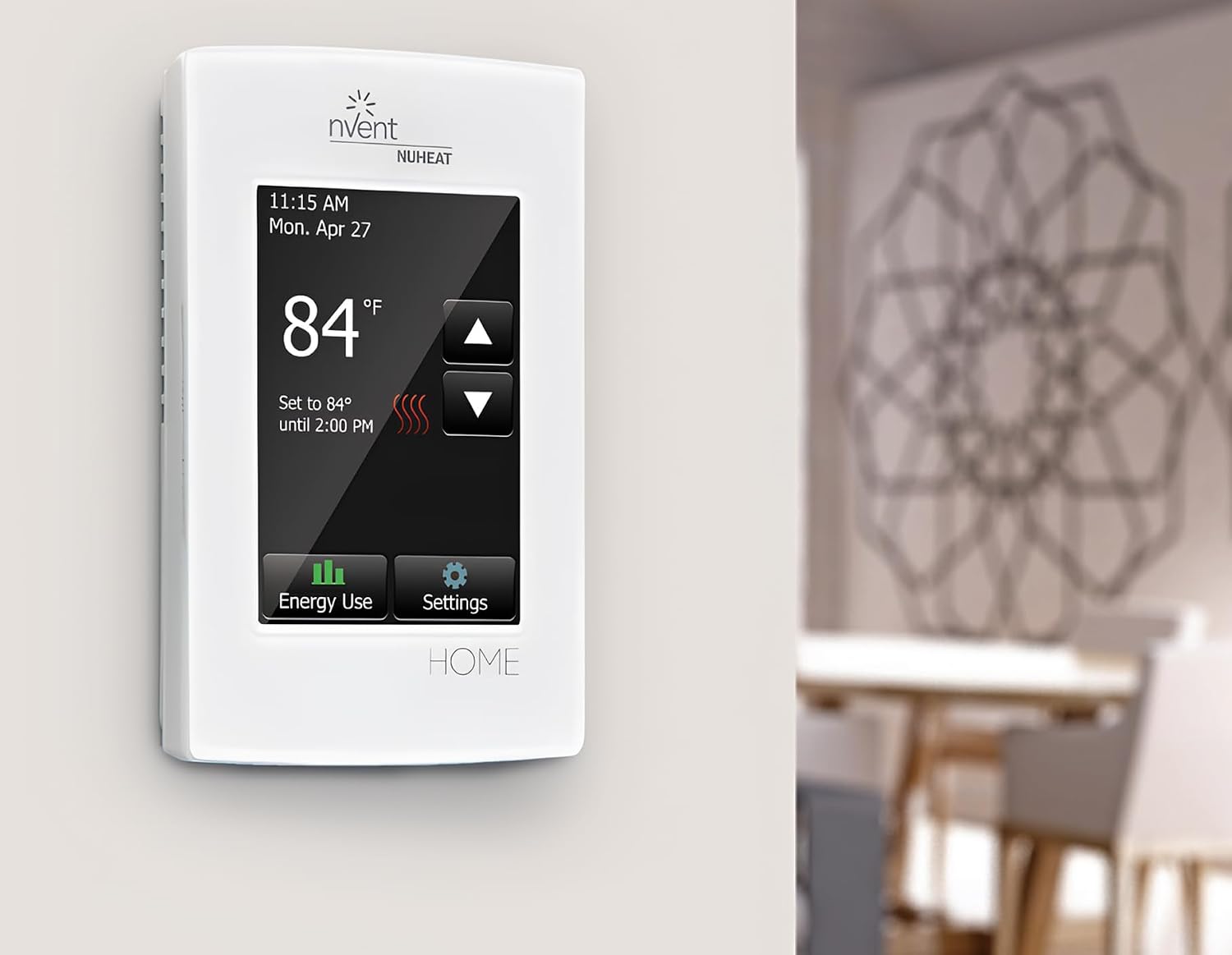
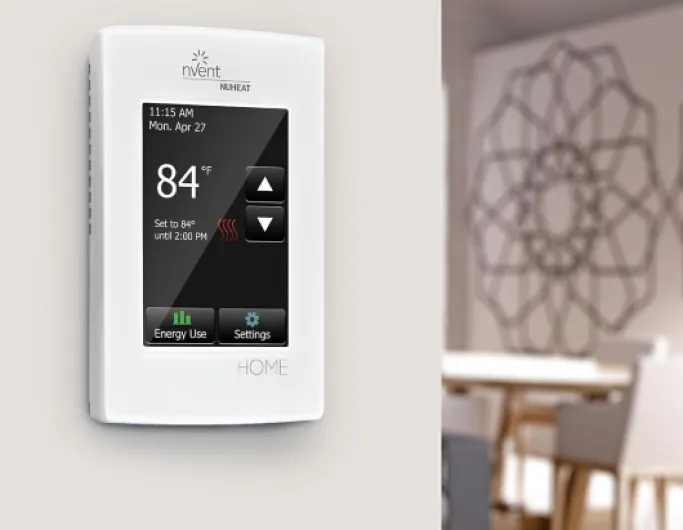
Visually, the Nuheat AC0056 is clean and basic. It has a high-gloss white frame and a rectangular touchscreen in the middle. It’s not ugly, but it’s also not the kind of thing you’d brag about. In a bathroom or hallway, it just blends into the wall, which is fine. Most people don’t want their floor thermostat to be the main design feature of the room.
The 3.5" color touchscreen is the main difference from older Nuheat models. The resolution (320×480) is decent; icons and numbers are clear enough, and the brightness is adjustable, which I appreciated. I lowered the brightness a bit so it doesn’t glow too much at night. The main home screen shows the time, date, and floor temperature in big, readable numbers, plus quick access to settings and energy usage. It’s very functional: not pretty like a smartphone, but it doesn’t feel cheap either.
Navigation is simple: you tap through menus and use plus/minus or arrows to adjust settings. There are no physical buttons on the front, which keeps the design clean. The touch response is okay: not as smooth as a phone, but I never had to jab the screen repeatedly. For a wall-mounted thermostat, it’s perfectly acceptable. The plastic frame is glossy, which looks nice when clean, but it does show fingerprints and dust more than a matte finish would. In a bathroom, that means a quick wipe every now and then if you care about appearance.
In terms of size, it’s not huge: about 7.6 cm wide and 12.7 cm high. It covers the hole of a standard electrical box and a bit more, so if you’re replacing an older stat, you probably won’t have ugly gaps around it. Overall, the design is practical and modern enough without trying too hard. If you want a thermostat that disappears visually and just does its job, this fits that description pretty well.
Durability and reliability: feels solid, but time will tell
Durability is always tricky to judge early on, but there are a few indicators. First, Nuheat gives a 3‑year manufacturer’s warranty, which is decent for a thermostat. It’s not lifetime coverage, but it’s enough that you don’t feel like it’s a disposable gadget. My previous Nuheat thermostat (older model) lasted roughly a decade before dying, so I’m expecting similar life from this one, though obviously no guarantees.
Physically, the unit feels sturdy enough for a wall device. The plastic housing doesn’t creak or flex when you press the screen. The terminals on the back for line, load, and sensor connections are solid and clamp wires properly. I’ve seen cheaper thermostats where the screw terminals feel flimsy or strip easily; that wasn’t the case here. Once mounted, it sits flush and doesn’t wiggle in the box, assuming your electrical box is properly installed.
From a reliability standpoint, I haven’t had any random resets, clock drift, or lost schedules. After a couple of brief power outages, it came back up with the correct time and kept the programming intact. That sounds basic, but I’ve dealt with thermostats that lose track of time every time the power flickers, which is annoying. The floor sensor included (OJ Electronics) is a known brand in this space and should be fine long term. I used the new sensor instead of the old one just to avoid any mismatch, and readings have been consistent.
That said, it’s still an electronic device with a touchscreen living in a bathroom environment. Steam, temperature swings, and occasional splashes are normal. It’s not waterproof, so you still need to mount it in a sensible spot away from direct water. If you install it correctly and your wiring is solid, I’d say it feels like a reliable, medium‑term investment, not something that will fall apart in a year. But if you want a thermostat that will survive 20+ years, you’re probably dreaming; for today’s standards, this one is respectable but not bulletproof.
Performance and daily use: programming, schedules, and energy usage
Day to day, the 7‑day programmability is what you interact with most. You can set different schedules for each day, with up to four time periods (wake, leave, return, sleep). Personally, I only use two periods for weekdays (morning and evening) and a simpler schedule for weekends. The nice part is you can disable unused periods, so you don’t get weird random temperature changes midday. Several Amazon reviewers mentioned this and I agree: being able to make unused periods inactive keeps things simple.
Programming itself is straightforward. The interface walks you through each step, and you’re mostly just tapping times and temperatures. Compared to my old 2011 Nuheat stat, this is way less painful. On the old one, changing the schedule felt like reprogramming a microwave from scratch. Here, you can tweak times quickly if your routine changes. I changed my weekday wake time a couple of times after noticing the floor was already warm too early, and it took maybe a minute each time.
The energy usage feature is a nice bonus. You can see hourly, weekly, and monthly data. It’s not insanely precise, but it’s enough to see patterns. For example, I noticed my floor was using more energy on weekends because I had left the temperature higher all day. After seeing that, I dropped the set point by a degree and shortened the warm period a bit. The next week’s usage went down. So it’s not just a gimmick; you can actually use it to fine-tune things and maybe shave a bit off your bill.
In terms of responsiveness, I never had freezes or weird lag in the menus. It boots quickly after a power cut and seems to remember its settings properly. The built-in Class A GFCI is also important from a performance/safety point of view: if there’s a ground fault in the floor system, it should trip and protect you. I thankfully haven’t had to test that in real life, but having it built in means you don’t need a separate GFCI breaker just for the floor, which simplifies the setup.
What this thermostat actually does (beyond the buzzwords)
On the spec sheet, the Nuheat nVent AC0056 is a programmable 7‑day floor heating thermostat with a 3.5" color touchscreen, dual voltage (120V/240V), built-in Class A GFCI, and compatibility with any electric floor heating that uses a 10KΩ sensor. In normal-person language: it’s a small wall screen that turns your heated floor on and off based on a schedule, and it works with most standard in-floor heating mats or cables.
The main functions you actually use day to day are pretty simple: you set the time, pick a schedule for each day of the week (wake, leave, return, sleep), and choose if you want it to control by floor temperature or ambient room temperature (depending on how your system is set up). There’s also a temperature limit (82°F) option that’s there to protect laminate or engineered wood floors so you don’t cook them by accident. I stuck with floor temperature mode for a tiled bathroom and it worked fine.
One thing that’s actually useful and not just a gimmick is the energy usage tracking. You can see hourly, weekly, and monthly usage. It’s not hyper-detailed like a power monitoring app, but it gives you a rough idea if your settings are wasting power or if your floor is running all day because you set the temp too high. For someone trying to keep hydro bills under control, it’s a handy sanity check.
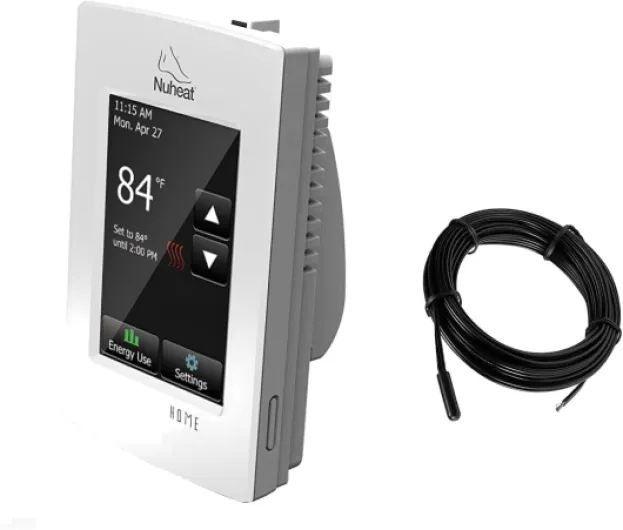
Out of the box, you get the thermostat, the floor sensor (OJ Electronics sensor), and the usual screws and manual. No extra fancy accessories. It’s meant to go in a standard electrical box. Overall, the presentation is pretty straightforward: no glossy marketing booklet, just a device that’s clearly aimed at people replacing an older Nuheat or similar unit and wanting something that’s simple, programmable, and safe rather than a flashy smart gadget.

Effectiveness: does it actually keep the floor at the right temperature?
This is the part that matters: does it keep the floor warm when you need it, without constant fiddling? In my experience, yes. Once I dialed in the schedule and the target temperature, it behaved predictably. When I set the floor to, say, 28°C (about 82°F) in the morning from 6 to 8 a.m., the tiles were warm by the time I stepped in, and they didn’t feel wildly hotter or colder than what was on the screen.
The built-in set-up wizard actually helps here. On first start, it walks you through basic settings: language, clock format, °C/°F, type of heating, and sensor. That sounds minor, but it prevents a lot of the usual guesswork. I liked that it had a test mode to make sure the floor sensor and load are wired correctly before you close everything up and walk away. I used that right after installation just to be sure I didn’t mess up the wiring, and it worked as expected.
The thermostat reacts reasonably quickly to changes. If you manually bump up the temperature, you hear the relay click and the floor starts heating. Obviously, in-floor systems are slow by nature, so don’t expect instant warmth, but that’s not the thermostat’s fault. What matters is that the measured temperature stays stable around the set point, and that was the case. I didn’t see big swings or random shut-offs. Also, the temperature limiting feature for laminate/engineered wood (82°F max) is a nice safety net if you’re using more sensitive flooring.
One thing to note: the Wi‑Fi mentioned in some specs is a bit misleading. This particular model (AC0056 basic) is more of a standalone programmable unit than a fully connected smart thermostat with app control. If you’re expecting to control it from your phone on vacation, you’ll likely be disappointed. As a pure floor heating controller, though, it’s solid. It heats when it should, stays off when it should, and doesn’t randomly reset or lose its schedule. That’s basically what I want from a thermostat like this.
Pros
- Easy replacement for older Nuheat and other 10KΩ sensor floor thermostats
- Clear 3.5" touchscreen with straightforward 7‑day programming and adjustable brightness
- Built-in Class A GFCI and temperature limit option for laminate/engineered wood floors
Cons
- No real modern smart-home/app control despite Wi‑Fi being mentioned in some specs
- Interface feels a bit dated compared to high-end smart thermostats
- Glossy plastic shows fingerprints and dust, and price is higher than basic non-touch models
Conclusion
Editor's rating
The Nuheat nVent Home AC0056 is basically a solid, modern replacement for older floor heating thermostats. It doesn’t try to be a smart-home centerpiece, and that’s fine. The touchscreen is clear, the 7‑day scheduling is simple enough that you don’t dread changing it, and the built-in GFCI plus floor sensor support give you the safety and compatibility you actually need. In daily use, it just quietly keeps the floor at the temperature you set, with no weird surprises.
If you already have a Nuheat mat or any 10KΩ sensor-based electric floor heating system and your old stat is dying or annoying, this is an easy upgrade. You’ll appreciate the better interface, quicker setup, and energy usage readouts. It’s especially suited for bathrooms and tiled areas, and the temperature limit feature helps if you’re on laminate or engineered wood. On the other hand, if you’re chasing full app control, advanced smart-home integration, or a super cheap basic box, this isn’t the ideal pick. It sits comfortably in the middle: not fancy, not bare-bones, just practical.
So who should get it? People who want reliable warm floors, a clear screen, and set‑and‑forget scheduling will be happy. Who should skip it? Anyone obsessed with smartphone control or those trying to spend the absolute minimum on a thermostat. For the average homeowner with electric floor heating, it’s good value and does its job without fuss.