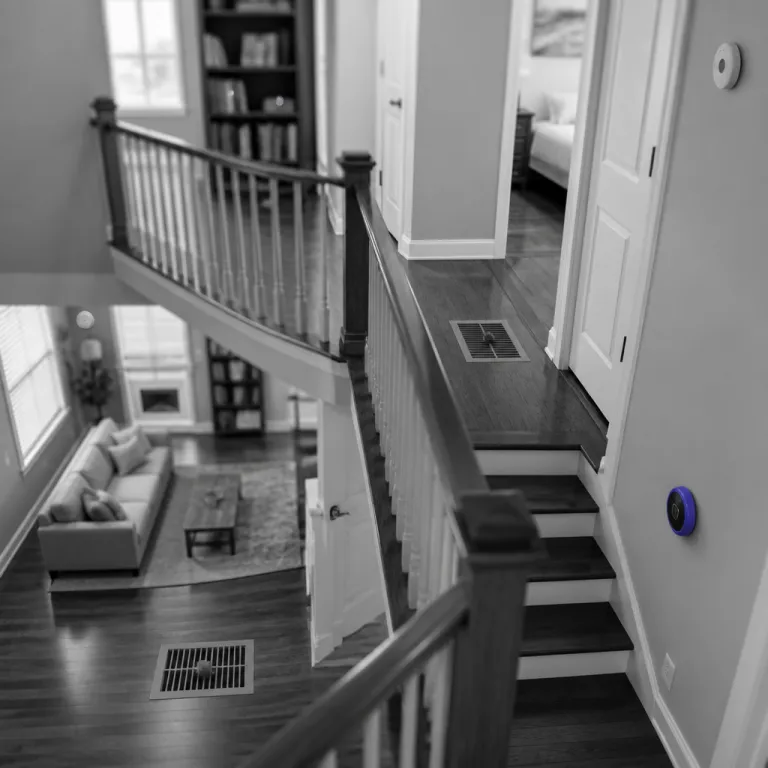
Why one smart thermostat struggles in a multi story home
A single smart thermostat in a multi story home is always guessing. It measures temperature in one hallway or living room, then tries to control comfort for every room and every floor. That works in a compact home, but in a tall house with stairs and long runs of ducted air, physics wins.
Warm air rises, cool air sinks, and that simple rule breaks many heating and cooling systems that rely on one thermostat and one set of assumptions. When the downstairs thermostat says 21 °C, the upstairs bedrooms in a typical home can quietly drift to 24 °C or higher, while a finished basement may sit at 18 °C and feel damp. The result is a smart thermostat setup that looks efficient on paper yet leaves people fighting over blankets and fans.
Most smart thermostats, whether a Nest thermostat, an Ecobee Smart Thermostat Premium, or a Honeywell Home T9, still depend on that single wall sensor unless you add accessories. The thermostat senses air in that one room, then cycles the system fan and compressor based on that reading alone. In a multi level house with long duct runs, partial insulation, and sun exposed rooms, that single sensor view is simply too narrow.
Owners often blame the smart home technology or the app interface when the real culprit is zoning, or rather the lack of it. A learning thermostat can adapt to your schedule, but it cannot rewrite gravity or change how hot air stacks at the top of the stairs. To close the upstairs downstairs gap with one thermostat, you need more data points, more nuanced control of air, and smart features that treat each room as its own micro climate.
Think of the thermostat as the brain and the HVAC system as the body, with ducts as arteries and vents as fingers and toes. In a multi story smart home, that brain needs extra eyes and ears in the form of wireless room sensors and sometimes smart vents to understand what is happening on each floor. Without those accessories, even the best connected thermostat systems from Google Nest, Ecobee, or Honeywell Home are flying half blind.
How room sensors reshape comfort in every room and floor
Room sensors are the simplest way to give a single smart thermostat a whole home, multi floor perspective. A small wireless sensor in an upstairs bedroom or basement rec room tells the main thermostat what the air feels like where people actually sleep or work. Instead of trusting one hallway reading, the system can average temperatures or prioritize specific rooms during key parts of the day.
Ecobee SmartSensor units pair with Ecobee Smart Thermostat Premium and Ecobee Smart Thermostat Enhanced models, and they are built around this multi room logic. You can set the thermostat to follow you, using motion detection in each sensor to decide which room matters most at a given time, or you can lock in a schedule based on rooms such as bedrooms at night and the home office during the day. In a multi story home, that means the thermostat no longer overheats the upstairs just to keep the downstairs couch comfortable.
Google Nest offers the Nest Temperature Sensor, which works with the Nest Thermostat and Nest Learning Thermostat, though with a simpler feature set. You choose which room sensor controls the thermostat at which time of day, then the Nest system adjusts heating or cooling to satisfy that room first. It is less dynamic than Ecobee’s motion based approach, but in a two story home with a clear day night pattern, it can still shrink a stubborn 3 °C gap between floors.
Placement matters more than brand when you deploy sensors across multiple rooms and floors. Avoid putting a sensor near a supply vent, a drafty window, or a direct sun patch, because that local air can mislead the thermostat about the true room temperature. In practice, a chest height shelf on an interior wall in the main bedroom or nursery gives the sensor a stable view of the air people actually breathe.
Smart sensors also unlock more precise scheduling and app based control for each room. Within the Ecobee or Nest app, you can build schedules that tell the thermostat which rooms to care about at which times, then let the system handle the rest. For homes with electric underfloor heating or a mini split in a bonus room, pairing a compatible Wi Fi thermostat for underfloor zones with a central learning thermostat and sensors can create a layered but coherent control system, as shown in many smart heating with timer and app control tests such as this smart thermostat for electric underfloor heating review.
Smart vents and airflow control when sensors are not enough
Room sensors tell the thermostat what is happening, but they do not move air on their own. When the upstairs still runs hot even after careful sensor placement and scheduling, smart vents can step in to redirect airflow. These motorized registers open and close automatically to push more conditioned air toward problem rooms and reduce flow to spaces that reach the set temperature first.
Brands such as Flair and Keen Home sell smart vents that replace standard floor or wall registers and connect to a central hub or directly to a thermostat compatible app. Paired with a smart thermostat in a multi level house, these vents can partially close in rooms that warm quickly, such as a sunny upstairs office, forcing more air toward cooler bedrooms or a shaded living room. The goal is not to shut any room completely, but to trim airflow enough that the system balances temperatures without stressing the blower motor.
Smart vents work best when the underlying HVAC system is in good shape and properly sized. If the furnace or heat pump is already struggling, closing vents aggressively can increase static pressure in the ducts and shorten equipment life, especially in older systems with marginal blower capacity. A quick check by an HVAC technician with a manometer is wise before you install a dozen smart vents across a multi story home.
Integration is another key piece of the puzzle, especially for a smart home enthusiast who already uses Amazon Alexa, Google Assistant, or Apple HomeKit. Some smart vent ecosystems talk directly to Ecobee smart thermostats or to a thermostat ecobee style add on, while others rely on a separate hub that coordinates with Amazon smart speakers or a Google Nest hub. Before you buy, confirm that the vent system, the thermostat, and your chosen voice assistant all share the same compatibility story.
In many cases, a hybrid approach delivers the best smart outcome for comfort and energy saving. Use room sensors to inform the thermostat about real temperatures on each floor, then deploy smart vents only in the most problematic rooms, such as the hottest bedroom or the coldest corner office. For wired multizone upgrades, a dedicated add on thermostat for multizone control can complement vents and sensors, as shown in tests of wired smart thermostat multizone control kits that replace existing wired thermostats while improving digital heating management.
Ceiling fans, air mixing, and the physics behind the gap
Even with the smartest thermostat and the most advanced features, air still behaves like air. Warm air pools near ceilings and at the top of stairwells, while cooler, denser air settles in basements and on lower floors. That natural stratification is why an upstairs hallway can feel stuffy while the downstairs sofa feels just right at the same thermostat set point.
Ceiling fans are the cheapest and most overlooked tool for managing this vertical temperature gradient in a multi story smart thermostat home. In summer, fans should spin counterclockwise to push air downward, increasing evaporation on your skin and making a 25 °C room feel closer to 23 °C without touching the thermostat. In winter, reversing the fan to a gentle clockwise direction pulls cool air up and pushes warm air down the walls, reducing the upstairs downstairs gap by one or two degrees in many homes.
Smart ceiling fans and fan controllers can tie into the same smart home system as your thermostat, sensors, and vents. With Amazon Alexa or Google Nest voice control, you can create routines that turn on bedroom fans when the thermostat ecobee or Nest thermostat reports a certain upstairs temperature, then slow them overnight as the air equalizes. This kind of automation does not change the HVAC system itself, but it changes how the air feels, which is what your body actually cares about.
Air quality also shifts between floors, especially in tightly sealed homes with lots of electronics and cooking on the main level. A thermostat premium model such as Ecobee Smart Thermostat Premium includes an air quality sensor that tracks volatile organic compounds and CO₂, then can trigger fan circulation to mix air more evenly. That circulation can slightly reduce temperature differences while also keeping stale air from lingering in a closed bedroom or loft.
For homes with a mini split serving an attic office or a converted garage, fan direction and speed still matter. A ductless mini split head mounted high on a wall will naturally trap warm air near the ceiling unless the built in fan runs enough to mix the room, so pairing that unit with a room sensor and a smart plug based fan can help align perceived comfort with the thermostat reading. The pattern holds across systems, from central air to mini splits and electric underfloor heating ; mixing air is often as powerful as lowering the set point.
Choosing the right smart thermostat and ecosystem for a multi story home
Not every smart thermostat handles a multi story home with equal grace. Some models are clearly built for zoning and sensor based control, while others focus more on sleek design or simple app control. The right choice depends on your wiring, your existing smart home devices, and how much you want to automate.
Ecobee Smart Thermostat Premium stands out for multi floor comfort because it ships with a SmartSensor in the box and supports many more. Its thermostat premium hardware includes a built in air quality sensor, far field voice microphones for Amazon Alexa, and robust scheduling tools that let you define which rooms matter at which times. If you already run a smart home with Alexa speakers and maybe a few Amazon smart plugs, Ecobee’s deep compatibility and sensor ecosystem make it one of the best smart options for taming an upstairs downstairs split.
Google Nest thermostats, including the Nest Thermostat and Nest Learning Thermostat, lean on elegant design and a strong learning thermostat algorithm. The Nest Learning model builds a schedule based on your manual adjustments, then refines it over time to balance comfort and energy saving, especially when paired with Nest Temperature Sensors in key rooms. For a multi story household that already uses Google Nest speakers and displays, this tight integration and simple app interface can be more important than the lack of built in air quality sensing.
Honeywell Home smart thermostats, such as the T9 and T10 Pro, sit somewhere between Ecobee and Nest in philosophy. They support room sensors, robust scheduling, and broad system compatibility, including many heat pump and dual fuel systems that older homes rely on. If your HVAC contractor prefers Honeywell system controls and you want a reliable, no drama thermostat with solid app control, a Honeywell Home model can be a pragmatic choice.
Whatever brand you choose, check the wire situation behind your existing thermostat before you buy. Many smart thermostats need a C wire for constant power, and while some include power adapters or use battery based tricks, a clean C wire connection is more reliable in the long run. For homeowners expanding into advanced voice and touchscreen control, a Control4 style interface that unifies thermostat, lighting, and audio can further streamline daily use, as shown in this analysis of a Control4 remote style smart thermostat interface that transforms voice and touchscreen control across the home.
When accessories are not enough and true zoning is the answer
There is a limit to what sensors, smart vents, and ceiling fans can fix. If your upstairs runs 5 °C hotter than downstairs in summer or the basement never climbs above 17 °C in winter, the underlying HVAC design may be the real problem. In those cases, a true two zone or three zone system with separate thermostats and motorized dampers is often the only durable solution.
A zoned system divides the ductwork into sections, each controlled by its own thermostat and damper, so the furnace or heat pump can send more air to one floor without over conditioning the others. In a multi story house, that usually means one thermostat for the main and upper floors and another for the basement, or one thermostat per floor in larger houses. Smart thermostats such as Ecobee, Nest, and Honeywell Home can all serve as zone controllers when wired correctly, but the design and installation should be handled by an experienced HVAC professional.
Retrofitting zoning into an existing home is not cheap, and it is not always possible if the duct layout is too constrained. Sometimes the better path is to add a dedicated mini split for the hottest or coldest floor, then let a central smart thermostat manage the rest of the system with help from sensors and smart vents. This hybrid approach can deliver precise room by room control where you need it most, while keeping the main system simple and reliable.
Before you commit to zoning, run a structured experiment with your current system and accessories. Use room sensors on each floor, adjust vent dampers manually, and track temperatures over several days of hot or cold weather using your thermostat app. If the gap shrinks to one or two degrees with these tweaks, a full zoning retrofit may not be worth the cost ; if the gap barely moves, zoning or a supplemental system becomes easier to justify.
Whatever path you choose, keep the focus on everyday comfort, not just on smart features or shiny hardware. A thermostat nest or thermostat ecobee model with every advanced feature still fails if your child’s bedroom stays too hot to sleep in July. In the end, the best smart systems are the ones you forget about most days, because the only reminder of their work is not the app interface, but the February gas bill.
Key figures on smart thermostats, zoning, and multi story comfort
- According to the U.S. Department of Energy, homeowners can save about 10 % per year on heating and cooling by turning their thermostat back 7 to 10 °F for 8 hours a day, which shows how powerful even basic scheduling can be in a multi level smart home (see energy.gov guidance on thermostat setbacks).
- Ecobee has reported that users of its smart thermostats with room sensors see up to 23 % savings on heating and cooling costs compared with holding a constant temperature, highlighting the impact of sensor based control in multi room and multi floor homes (based on Ecobee internal analysis of customer data).
- Studies from the Lawrence Berkeley National Laboratory have found that poorly balanced duct systems can create temperature differences of 3 to 6 °C between rooms, which explains why single thermostat systems often struggle in two story and three story houses (see LBNL research on residential duct performance).
- Data from ENERGY STAR shows that heating and cooling typically account for about 40 % of a home’s energy use, so improvements in thermostat control, zoning, and air distribution can have an outsized effect on overall household energy bills.
- Field measurements by HVAC contractors commonly show that closing more than 20 to 30 % of vents in a duct system can raise static pressure beyond manufacturer limits, which is why smart vents must be deployed carefully and usually only in a subset of rooms.
| Upgrade | Main benefit | Typical impact |
|---|---|---|
| Room sensors | More accurate temperature readings where people spend time | Can cut floor to floor gaps from ~3–4 °C to ~1–2 °C |
| Smart vents | Redirect airflow toward hot or cold rooms | Best used on up to ~20–30 % of vents to avoid high static pressure |
| Ceiling fans | Mix stratified air and improve perceived comfort | Often lets you raise or lower set point by ~1–2 °C |
| Full zoning | Independent control for each floor or area | Solves persistent 4+ °C differences when accessories are not enough |
FAQ about smart thermostats and upstairs downstairs temperature gaps
Can one smart thermostat really fix a multi story temperature imbalance ?
One smart thermostat can significantly reduce a multi story temperature imbalance when paired with room sensors, careful scheduling, and sometimes smart vents. It cannot fully overcome severe duct design problems or an undersized system, but it can often shrink a 3 to 4 °C gap to a more tolerable 1 to 2 °C. For larger gaps, true zoning or a supplemental mini split is usually required.
Where should I place sensors in a two story home for best results ?
Place sensors in the rooms where comfort matters most, such as the main bedroom, nursery, and home office, rather than in hallways or near stairwells. Mount them away from supply vents, exterior doors, and direct sunlight to avoid misleading temperature spikes. A good rule is chest height on an interior wall in each priority room.
Are smart vents safe for my HVAC system in a multi story house ?
Smart vents are generally safe when used in moderation and in systems that are in good condition. Problems arise when too many vents are closed at once, which can raise duct static pressure and strain the blower motor. Before installing a large number of smart vents, have an HVAC professional check your system’s capacity and pressure limits.
How do ceiling fans interact with smart thermostats and sensors ?
Ceiling fans do not change the actual air temperature, but they change how warm or cool you feel by moving air across your skin. When coordinated with smart thermostats and sensors, fans can let you raise the set point by one or two degrees while maintaining comfort, especially in upstairs bedrooms. Smart fan controls and voice assistants make it easier to automate this interaction based on room temperature readings.
When should I consider a fully zoned HVAC system instead of accessories ?
You should consider a fully zoned HVAC system when temperature differences between floors remain larger than about 3 to 4 °C even after using sensors, smart vents, and fan strategies. Persistent hot or cold spots, short cycling equipment, or rooms that never reach the set temperature are strong signs that duct design or system sizing is the core issue. In those cases, adding motorized dampers and separate thermostats for each zone usually delivers more reliable comfort than piling on more accessories.