
Summary
Editor's rating
Value: good features for the price, with a few compromises
Design: looks decent, with a few annoyances
Performance: it heats the floor properly and stays connected
Installation & setup: easy enough if you’re comfortable with mains wiring
What this thermostat actually does (beyond the buzzwords)
Effectiveness: does it actually save energy and make life easier?
Pros
- Works reliably with electric underfloor heating and follows schedules accurately
- Strong smart home support (Matter, HomeKit, Alexa, Google, Home Assistant) without needing a hub
- Good app experience with clear scheduling, override options, and basic energy reports
Cons
- Smaller faceplate and slightly greyish colour may not cover or match some wall boxes and switches
- Installation can be tight in shallow or crowded back boxes due to unit depth and wiring space
- Wi‑Fi setup limited to 2.4 GHz and can be fussy with combined 2.4/5 GHz networks

Specifications
View full product page →| Brand | meross |
Smart heating without the headache?
I installed the Meross MTS215 smart thermostat on an electric underfloor heating loop in a small bathroom and used it for a few weeks before writing this. I’m not an electrician, just reasonably handy, and I already had a basic wired thermostat in place. I mainly wanted three things: proper schedules, app control from my phone, and something that works with HomeKit and Matter without needing yet another hub.
In day-to-day use, this thing is pretty straightforward. It sits on the wall like a normal thermostat, but you can control it via the Meross app, Apple Home, Alexa, Google, and even Home Assistant. I tried it with HomeKit and Home Assistant; both worked, with only a bit of fiddling on the Wi‑Fi side. The heating itself behaved as expected – when I set 24 °C floor temp, it hit it and kept it there within reason.
What stood out quickly is that it feels more like a decent appliance than a toy. The touch buttons respond well, the screen is clear enough, and once you’ve set your schedules you mostly forget it’s there. It doesn’t randomly drop Wi‑Fi or reset, which is more than I can say for some cheap smart gear I’ve used before. The override function (temporary manual change that falls back to schedule) is actually useful in real life.
It’s not perfect though. The body is a bit deeper than some older thermostats, which makes fitting it into shallow or crowded back boxes a bit annoying. The front plate colour is slightly greyish rather than pure white, so if your other switches are bright white, you’ll notice. And if you have a plasterboard fast-fix box, the smaller face might not fully cover the cut-out, which can look a bit rough. Overall, solid device, but not the prettiest or easiest fit in every wall box.
Value: good features for the price, with a few compromises
In terms of value for money, this thermostat sits in a nice spot. It’s usually cheaper than a lot of branded underfloor controllers (like some Warmup units) but still gives you a full smart feature set: Matter, HomeKit, Alexa, Google, Home Assistant, proper scheduling, open-window detection, energy reports, and a 2‑year warranty. Compared to some basic non-smart thermostats, you’re paying more upfront, but you’re getting easier control and the potential to trim wasted heating time.
Where it earns points is that it’s hubless – you don’t need to buy a separate gateway. If you already have a mixed smart home (Apple, Google, Alexa, maybe Home Assistant), this just slots in without forcing you into a new ecosystem. The Meross app is also decent: not perfect, but responsive and clear enough, with a scheduling interface that’s better than a lot of budget brands. For the price bracket, the overall experience feels more polished than cheap no-name Wi‑Fi thermostats I’ve tried.
On the downside, you are still buying a budget-to-midrange Chinese-made device, so don’t expect premium materials or perfect finishing. The slightly greyish front, the smaller faceplate that might not cover messy boxes, and the deeper body are the main compromises. If you care a lot about aesthetics or you want a big brand with local support, you might prefer something more expensive from a heating specialist. Also, if you don’t care about smart features at all, a simple programmable thermostat could be cheaper and will still control the floor just fine.
For most people who already use smart assistants or HomeKit and want to modernise their electric underfloor heating without spending a fortune, I’d call the value pretty solid. It gets the job done, has the right integrations, and doesn’t feel like a toy. Just go in knowing you’re paying for functionality and ecosystem support, not luxury design or ultra-premium build.
Design: looks decent, with a few annoyances
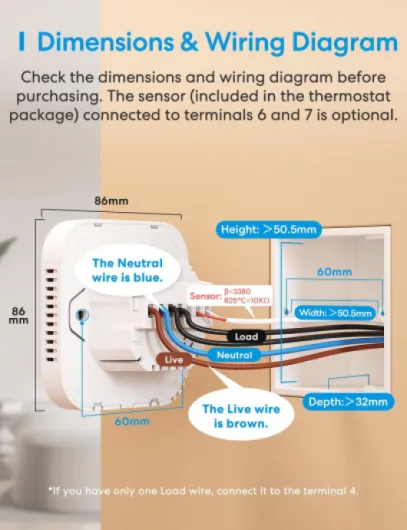
Design-wise, the Meross thermostat goes for the minimal white glass-front square look. It’s 8.6 x 8.6 cm, so a bit smaller than some older controllers like some Warmup units or bigger generic ones. On the wall, it looks modern enough, nothing flashy. The LED display is bright and clear, and you can dim it, which is nice if it’s in a bedroom or somewhere you don’t want a glowing square all night. The touch buttons are hidden under the glass, so it looks clean when off.
The smaller footprint is a double-edged sword. On a solid wall with a neat back box, it looks tidy. But if you have a plasterboard fast-fix box or a slightly oversized cut-out, the edges of the hole can stick out around the thermostat because the faceplate doesn’t fully cover it. That’s not a functional problem, just cosmetic, but once you see it you can’t unsee it. One Amazon reviewer mentioned exactly this, and I had a similar issue where it didn’t fully hide a slightly messy cut in the tile.
Another detail: the front is not a pure bright white. It’s more like a light grey/soft white. Next to my other switches (pure white plastic), it looks slightly off. Not ugly, just not matching. If you’re super picky about all your wall gear lining up visually, this might bug you. Personally, I got used to it after a few days, but I did notice it right away. Also, the unit is a bit deeper than some older thermostats, so you end up wrestling the wires into the back box if it’s already crowded.
On the positive side, the screen is genuinely readable. Temperature and icons are clear even in daylight, and the dimming works fine. Touch controls are responsive; you don’t have to stab it repeatedly. The child lock is also easy to spot and activate, which is good if you’ve got kids who like pressing random buttons. Overall, the design is functional and modern, but not perfect. It looks pretty solid in most setups, but if your wall cutouts are messy or you care a lot about colour matching, expect a bit of compromise.
Performance: it heats the floor properly and stays connected
In daily use, the core performance is solid: it turns the electric underfloor heating on and off reliably, tracks the temperature reasonably well, and follows the schedule without doing anything weird. I used it in a bathroom with an existing floor sensor and reused that sensor instead of the one in the box, which the thermostat handled without complaining. When I set a temperature, the relays click on, the floor heats, and it stabilises close to the target. No random overshooting or staying cold.
On the smart side, Wi‑Fi stability was good. Once I got it onto my 2.4 GHz network (I had to temporarily split my 2.4/5 GHz SSID like one reviewer mentioned), it stayed connected. No dropouts in HomeKit or in the Meross app over a couple of weeks. Commands from my phone or from Home Assistant showed up on the thermostat within a second or two. I could be away from home and still toggle it or change the setpoint, which is exactly what I wanted for preheating the floor before a shower.
The scheduling is flexible: up to 8 periods per day. You can set different temps for each period and copy schedules across days, which saves time. The override feature is actually one of the better parts. You can decide how long an override lasts before it falls back to the schedule, which is great in a bathroom. For example, mine is set for 6–8 am, but if I get up early I can manually turn it off after my shower, or if I get up late I can extend it for an hour. The thermostat then automatically returns to the normal programme.
Open-window detection is there, but I’d call it nice to have, not magic. If the room temperature suddenly drops, it pauses heating for a bit to avoid wasting power. It works in a basic way, but don’t expect it to perfectly detect every little draft. For energy reporting, the app shows usage trends and temperature history. It’s not as deep as some dedicated energy monitors, but it’s enough to see patterns, like how long the floor is heating each day. Overall, performance-wise, it does the job: heats the floor, follows schedules, responds quickly to app/voice, and doesn’t lose connection all the time.
Installation & setup: easy enough if you’re comfortable with mains wiring
Installing the Meross thermostat is not rocket science, but you are dealing with mains voltage, so if you’re not comfortable with wiring, get an electrician. In my case, I replaced an existing wired underfloor thermostat. Power off at the breaker, remove old unit, label the wires (the included stickers actually help), and move them over to the clearly marked terminals on the Meross base. The manual is basic but clear enough for a like-for-like swap.
The main hassle is physical space in the back box. The Meross unit is a bit deeper than some older controllers, and if your wall box is shallow or already crammed with thick cables, you’ll be pushing and folding wires to get it to sit flush. One reviewer mentioned using their own longer screws to make it easier to fit; I ended up doing something similar. It’s a one-time pain, but worth knowing about before you start. Once the base is screwed on, the front just clips on and it looks neat.
Wi‑Fi and app setup is where things can get slightly annoying. It only works on 2.4 GHz, like most smart home stuff. If your router uses a single SSID for both 2.4 and 5 GHz, the pairing can fail. I had to temporarily split my Wi‑Fi bands or move far enough from the router that my phone latched onto 2.4 GHz only. After that, pairing with the Meross app was quick, then adding it to Apple HomeKit and Home Assistant was straightforward. One small gripe: the HomeKit/Matter setup code sticker is on the front protective film, which is dumb – once you peel it off and throw it away, you’ve lost the code unless you save it somewhere.
Overall, I’d say installation is manageable for a competent DIYer, but not totally plug-and-play. Expect 10–20 minutes if you’re swapping an existing thermostat, plus a bit of time fighting your Wi‑Fi if your router setup is odd. If you’re starting from scratch with no wiring or no back box, that’s a different story and probably a job for a pro. Once it’s in and paired, though, you’re basically done – you set your schedules once, test the floor heating, and then just tweak as needed.
What this thermostat actually does (beyond the buzzwords)
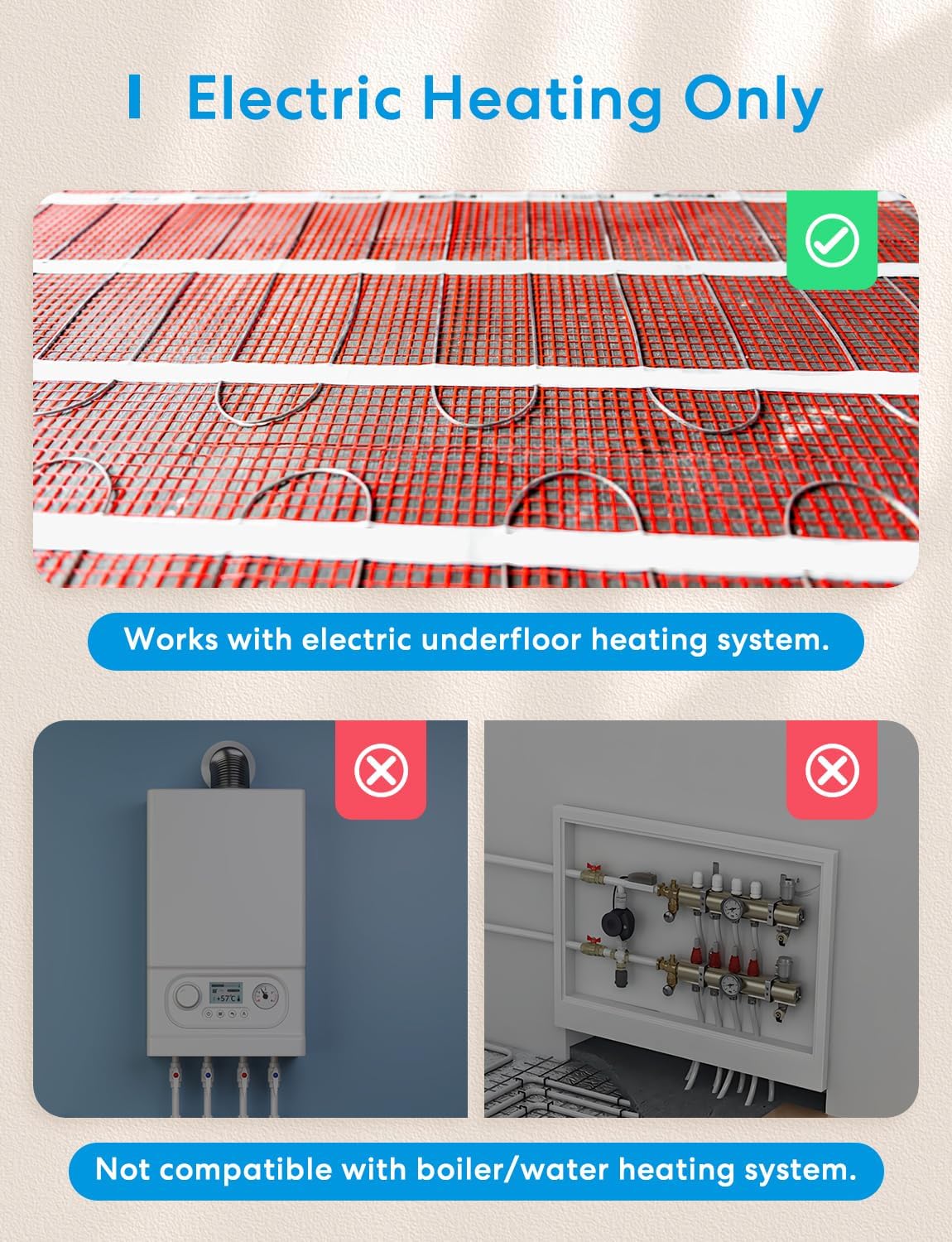
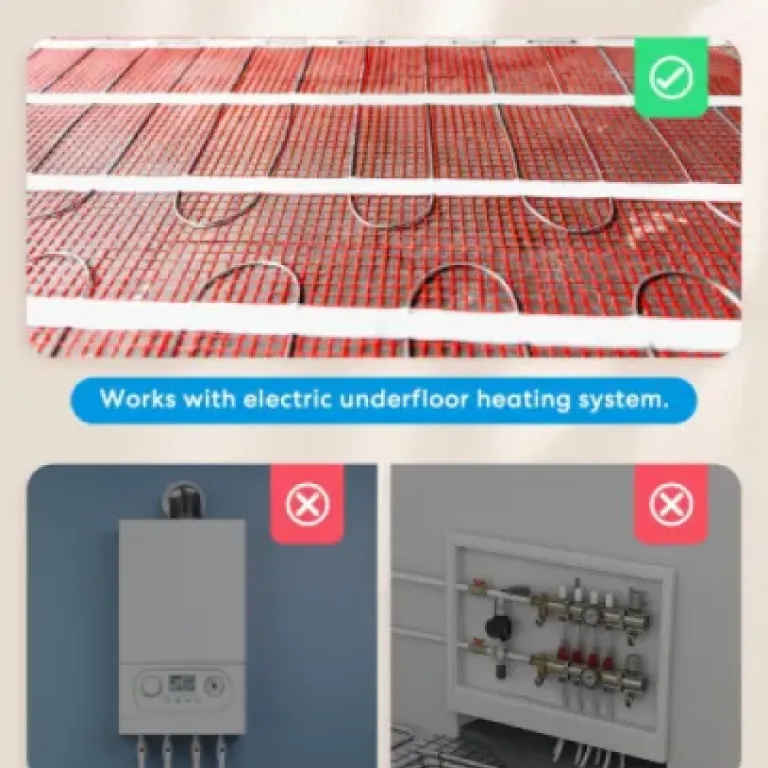
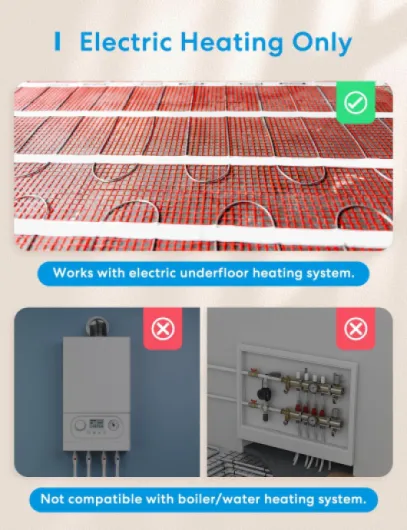
On paper, the Meross MTS215 ticks a lot of boxes. It’s a wall-mounted smart thermostat specifically for electric underfloor heating, not water-based systems. It needs live and neutral, runs up to 250 V, and mounts on a standard 86 mm box. In the box you get the thermostat, a floor sensor probe, screws, and a basic manual. That’s it – no hub, no extra gateway. It connects straight to 2.4 GHz Wi‑Fi.
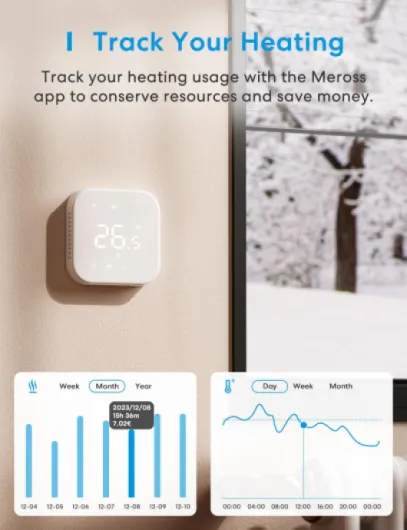
Feature-wise, you get up to 8 programmable periods per day, child lock, open-window detection, dimmable LED screen, memory after power cuts, and support for Matter, HomeKit, Alexa, Google, SmartThings, and Home Assistant. In practice, that means you can schedule warm floors in the morning, cooler settings during the day, and bump it up from your phone when you feel like it. The app also shows energy and temperature history, which is handy if you’re trying to cut bills or just see how often the floor is actually heating.
One thing I liked is that it supports multi-zone control, but in a realistic way. You don’t have a single box trying to manage the whole house; instead, you put one thermostat per room/zone, and the Meross app and your smart home platform let you group and control them. I only had it in one bathroom, but I can see this being decent for several rooms if you’re already invested in smart home stuff. The optional external sensor also gives you more flexibility for bathrooms and saunas, especially if the floor sensor is already tiled in.
Overall, in terms of raw functions, it’s pretty stacked for the price. You’re not missing any key features you’d expect from a modern smart thermostat: schedules, app, voice, Matter, basic energy reporting, window detection, and a child lock. Where it’s less impressive is the small design quirks (size, colour) and the usual Wi‑Fi setup annoyance if your router combines 2.4 and 5 GHz under one name. But if you just want something that controls underfloor heating reliably and plays nice with different ecosystems, it covers the basics well.
Effectiveness: does it actually save energy and make life easier?
Effectiveness for me is: does this thermostat keep the room/floor comfortable and help me use less energy without constant fiddling. On that front, it’s pretty decent. After a few days of tweaking the schedule, I ended up with warm floors when I needed them (early morning and evening) and lower temps during the day and night. I stopped manually turning the heating on and off, which is usually when I forget and end up wasting power.
The energy reports in the Meross app are simple but useful. You see when the heating is running and can roughly judge how long it’s on each day. If you’re trying to cut costs, it makes it easier to spot if you’re heating a room for no reason. Is it going to magically save 30% on your bill on its own? No. But combined with sensible schedules and the open-window detection, you can definitely trim some waste compared to a dumb thermostat you leave on too long. The open-window function did trigger a couple of times when I aired out the bathroom and it paused heating for a while, which is exactly the point.
Voice and app control genuinely change how you use it. Instead of walking over and poking a plastic dial, you just tell Siri/Alexa or use your phone. For me, the most useful case was lying in bed and realising I’d left the bathroom heating on – quick toggle in the app and done. Also, every family member with the app can control it, so you don’t get the “who messed with the thermostat?” battle as much, because you can see what’s going on in the history.
Overall, I’d say effectiveness is good, not mind-blowing. It won’t turn a bad-insulated room into an energy miracle, but it gives you the tools to control the heating properly: schedules, remote access, simple energy info, and some automation. If you’re upgrading from a basic manual thermostat, you’ll probably notice more consistent comfort and less pointless heating time. If you’re already on a decent programmable unit, the gains are more about convenience and integration with your smart home than huge savings.
Pros
- Works reliably with electric underfloor heating and follows schedules accurately
- Strong smart home support (Matter, HomeKit, Alexa, Google, Home Assistant) without needing a hub
- Good app experience with clear scheduling, override options, and basic energy reports
Cons
- Smaller faceplate and slightly greyish colour may not cover or match some wall boxes and switches
- Installation can be tight in shallow or crowded back boxes due to unit depth and wiring space
- Wi‑Fi setup limited to 2.4 GHz and can be fussy with combined 2.4/5 GHz networks
Conclusion
Editor's rating
Overall, the Meross MTS215 is a practical smart thermostat for electric underfloor heating that focuses on doing the basics properly: it heats when it should, follows schedules, and stays connected to Wi‑Fi and your smart home platforms. If you’re coming from a dumb manual controller or an older clunky programmable unit, the jump in convenience is noticeable. App control, voice commands, and an actually usable scheduling interface make it much easier to run the heating only when you need it.
It’s not flawless. The slightly smaller faceplate can expose messy wall boxes, the colour isn’t a perfect match for pure white switches, and installation can be a bit cramped in shallow boxes. You also have the usual 2.4 GHz Wi‑Fi pairing annoyance. But once installed, it’s been reliable and straightforward, and that matters more to me than fancy looks. The integration with Matter, HomeKit, Alexa, Google, and Home Assistant is a strong point at this price, and the override plus energy-report features are genuinely useful in daily life.
I’d recommend this to people who already have or plan to have a smart home setup and want to upgrade electric underfloor heating without overspending. It makes sense for bathrooms, bedrooms, and small living areas where comfort and timing matter. If you’re extremely picky about wall aesthetics or want the absolute simplest, no-app solution, you might be happier with a plain programmable thermostat or a more premium brand. For most average users who just want warm floors, remote control, and decent energy awareness, it’s a good, no-nonsense choice.