
Summary
Editor's rating
Is it good value compared to other underfloor stats?
Simple square, looks modern enough but not fancy
Build quality and long-term feel after a few weeks
Heating performance and smart features in day-to-day use
What it actually is and what it can (and can’t) do
Does it really make heating easier and cheaper?
Pros
- Easy to install as a replacement for existing electric underfloor thermostats (can reuse existing floor sensor)
- Reliable app and Alexa/Google control with simple scheduling and remote access
- Stable temperature control with dual sensors and useful features like open-window detection and child lock
Cons
- App and energy reports are basic and not very polished
- Screen goes completely dark when idle, which can be confusing at first
- Requires neutral wire and 2.4 GHz Wi‑Fi, so not compatible with every setup

Specifications
View full product page →| Brand | meross |
A smart thermostat that doesn’t try to be too clever
I put this Meross smart thermostat (MTS205) in my bathroom to replace an old dumb underfloor controller that was stuck on a weird schedule and a tiny cryptic screen. I’ve been using it daily for a few weeks now. In short: it does what it says, the app control is handy, and it’s not perfect, but for the price it’s pretty solid.
Before this, changing the floor heating schedule meant digging out the manual, clicking through awful menus, and usually giving up. With this one, once it was wired in and on Wi‑Fi, I basically stopped touching the physical unit and just used my phone or Alexa. That’s the main win here: you stop fighting with the little box on the wall.
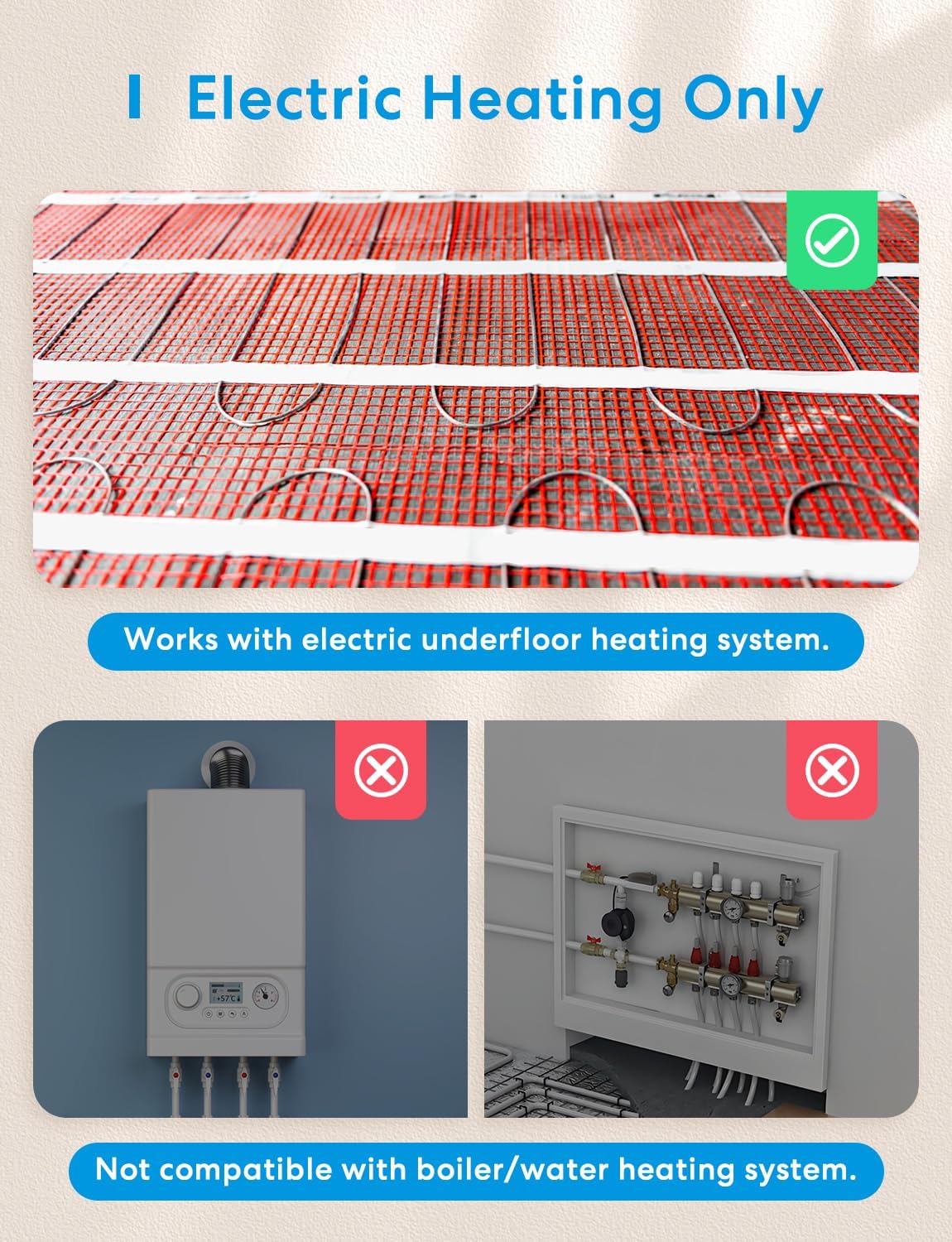
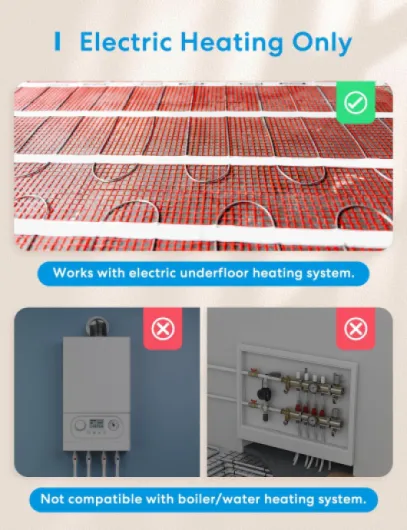
I used it with electric underfloor heating on a 230 V circuit, no water-based system, no boiler, just straight electric mat. My setup is pretty standard: 2.4 GHz Wi‑Fi, a couple of Alexa devices, and a normal UK-style back box in the wall. The thermostat fit in without drama and picked up my existing floor sensor just fine, although it also comes with its own sensor cable in the box.
If you’re expecting some ultra-premium bit of kit with fancy animations and a glossy app, that’s not what this is. It’s a simple square thermostat with a glass front, basic LED display and a functional app. The thing I liked is that it focuses on the basics: heat when I need it, simple schedules, and remote control. It’s not perfect – the app can be a bit clunky and the screen behaviour is slightly odd – but overall it gets the job done without much hassle.
Is it good value compared to other underfloor stats?
Price-wise, this Meross unit sits in the mid-range for smart underfloor thermostats. It’s noticeably cheaper than some big-brand models like Warmup’s fancier 6ie/4ie type controllers, but more expensive than a basic non-smart thermostat. For me, the value comes from the fact that you actually use the smart features every day, not just once at setup. App control, quick scheduling, and Alexa routines are things I use constantly, so I feel like I’m getting something for the extra money.
Compared to my old dumb stat, the difference in comfort is clear. Compared to something like the Warmup 6ie (which I briefly tried and then returned), the Meross is less flashy but far easier to get online and keep stable. I didn’t have to reconfigure my whole network or fight with support. It just joined Wi‑Fi, showed up in the app, and Alexa found it with the skill. That alone is worth quite a bit if you don’t enjoy wasting an evening on pairing issues.
In terms of what you get in the box, it’s pretty fair: the thermostat, a floor sensor, and a manual. No extra frames or fancy accessories, but you don’t really need them. The fact that it can reuse an existing floor sensor also saves money and hassle if you’re upgrading an older system. The 2‑year warranty is fine; I’ve seen similar or less from other brands in this category.
If you want deep analytics, ultra-polished apps, or integration with every home automation platform under the sun, you might find it a bit basic. But if your goal is “stop wasting electricity on underfloor heating and control it easily from my phone or voice assistant”, then the price feels reasonable. I’d call the value good, not mind-blowing: you’re paying a fair amount for real convenience and some energy savings, without paying a premium just for the brand name.
Simple square, looks modern enough but not fancy
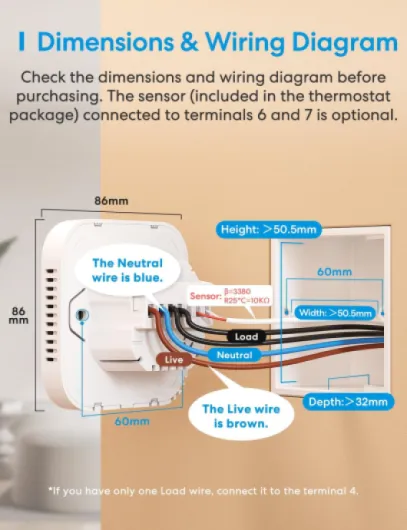
Design-wise, this thing is a plain white square with a glass touch front. It’s about 8.6 x 8.6 cm, so roughly the size of a standard wall thermostat, just a bit more modern-looking. The display is LED behind the glass, and the touch buttons are not physically marked, so you mainly rely on the icons that light up. It blends into a white wall nicely and doesn’t scream for attention, which I liked. It’s not some showpiece, it just looks clean.
The interface on the unit itself is basic: temperature, heating icon, and a couple of touch areas for up/down and mode. I found it usable but not something I’d want to rely on for detailed programming. The touch sensitivity is fine; I didn’t have to jab it repeatedly. One slightly odd thing: when the heating is off and you’re not touching it, the screen can go completely dark, so the first time you see that you might think it’s dead. A quick tap brings it back, but I would have liked a tiny always-on indicator showing it has power.
In terms of practical design, it’s meant for embedded installation into a standard 86 mm or 67 mm box. In my case, it fit a UK back box without any bodging, and it sits pretty flush against the wall. There’s no dedicated earth terminal on the front, which matches what some reviewers mentioned. You can park the earth wires in a spare terminal in the back, but it feels like Meross could just have given a clearly marked earth point; would make things cleaner for DIY users.
The overall feel is more “decent consumer electronics” than “premium hardware”. The glass front is nice, the plastic body is standard PC material, and the build doesn’t feel flimsy. It doesn’t look cheap on the wall, but it also doesn’t pretend to be high-end designer gear. For a bathroom or hallway, I think the design is absolutely fine and fits most modern interiors without drawing attention.
Build quality and long-term feel after a few weeks
Durability is always tricky to judge early, but I can at least talk about build quality and day-to-day robustness. The unit feels solid in the hand, not hollow or flimsy. The glass front doesn’t flex, and the plastic housing doesn’t creak when you press it into the wall box. The relay click when it switches heating on/off is firm but not loud. It’s rated for 230 V and comes with a 2‑year manufacturer warranty, which is pretty standard in this price range.
After a few weeks of use, I haven’t had any random reboots, Wi‑Fi drops, or ghost touches. The touch buttons still respond consistently, and the screen brightness hasn’t changed. It’s installed in a bathroom (not directly in the shower area, obviously), and it’s been fine with the usual humidity from showers. There’s no visible condensation inside the screen or anything like that. I wouldn’t splash water directly on it, but as a wall thermostat in a typical bathroom zone, it seems comfortable.
On the wiring side, the terminals are decent quality and grip the wires well. I’ve re-opened the unit once to check the connections after a week (paranoid habit), and nothing had loosened. The included floor sensor cable also looks sturdy enough, though I reused my existing sensor since it was already embedded in the floor. It’s good that the thermostat can work with the old sensor; otherwise, ripping up tiles would’ve been a non-starter.
Long-term, the main risk with any Wi‑Fi thermostat is software support. Meross has been around a while and still updates their app, so I’m not too worried, but obviously if they ever stopped maintaining their cloud, some smart functions might suffer. The nice part is that, worst case, the unit can still work as a local thermostat with manual control. From the hardware feel and the two-year warranty, I’d say durability is likely decent for normal home use, as long as you don’t install it in a crazy damp or dusty environment.
Heating performance and smart features in day-to-day use
In daily use, the temperature control is steady and predictable. I set my bathroom floor to 24–25 °C using the floor sensor, and it stays in that zone without big swings. The ±0.5 °C claim feels about right – you don’t get that on/off rollercoaster some cheap thermostats have. When it calls for heat, the relay clicks, the heating icon lights up, and the floor warms up at the pace you’d expect from an electric mat.
The scheduling works as advertised. I set up a weekday schedule with a warm floor before my morning shower and a lower temp during the day, then a small boost in the evening. You can have up to 8 periods per day, which is more than I need. The nice part is doing all of this from the app instead of poking at tiny buttons. Compared to my previous basic controller, it’s just less annoying. If I change my wake-up time, I can tweak the schedule in under a minute from my phone.
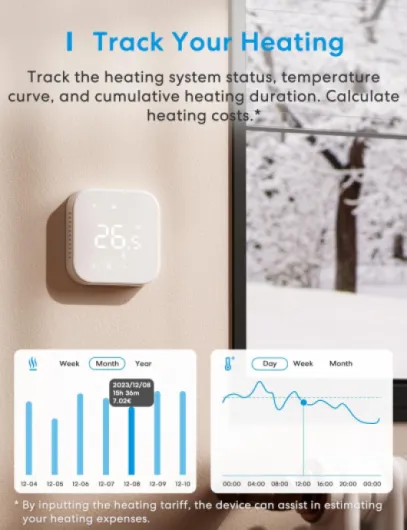
The open-window detection is an interesting feature. I tested it by opening the bathroom window wide while the floor was on. After a short time, the thermostat noticed the sudden temperature drop and temporarily cut the heating to avoid blasting power into a cold room. It’s not magic, but it does help avoid wasting electricity when you’re airing the room. The app also shows basic energy usage per day and week. It’s not super detailed, but it gives you a rough idea of how much the heating is running. I did see a small drop in my usage compared to having the floor on a dumb always-on morning schedule.
Voice control with Alexa is where the “smart” part really clicks. I set up routines like “turn on bathroom floor” an hour before my alarm, and it just works. I can also say “Alexa, set bathroom floor to 25 degrees” and it responds quickly. Cloud control from outside the house also worked fine; I turned the floor on from the supermarket just to check, and by the time I got home the tiles were warming up. Overall, performance is solid: it heats properly, follows schedules, and the smart bits actually get used, not just listed on the box.
What it actually is and what it can (and can’t) do
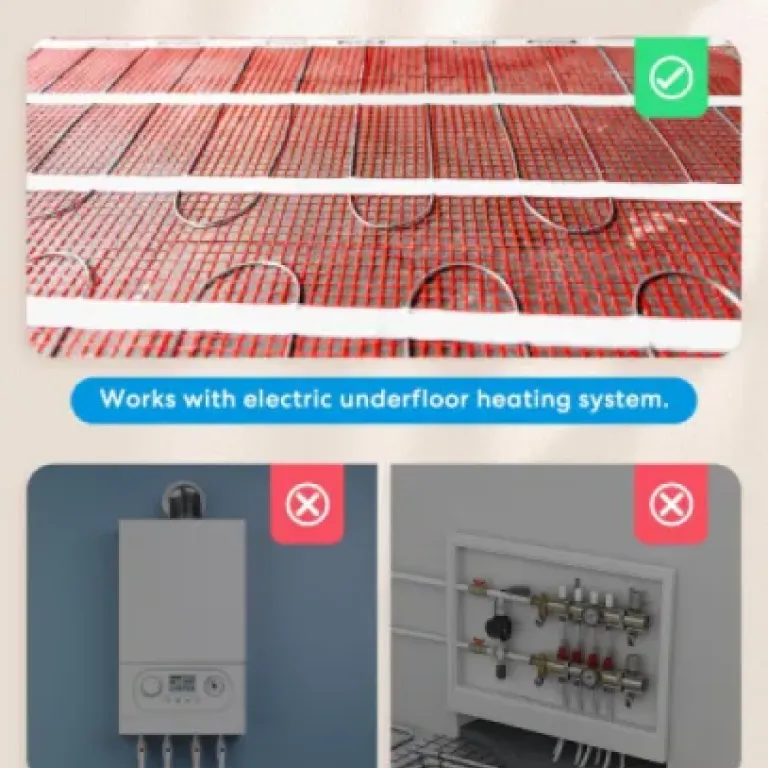
This is a smart thermostat specifically for electric underfloor heating, not for radiators, not for a gas boiler, and not for water-based underfloor systems. It’s 230 V, wall-mounted, and you need both live and neutral at the box. No batteries, no hub, just Wi‑Fi (2.4 GHz only). It supports both heating and cooling, but realistically most people will just use the heating mode for floors.
You control it with the Meross app, and it also hooks into Alexa, Google Assistant, and apparently SmartThings. I only tested Alexa and the native Meross app. The thermostat can use two sensors: one in the air (built-in) and one in the floor (wired probe). You can choose in the settings if it should control based on floor temp, air temp, or a mix, which is useful if you have wood floors or just care about how warm the room feels rather than how hot the tiles get.
In terms of features, you get up to 8 programmable periods per day, energy-use tracking in the app, open-window detection (it cuts heating for a while if it sees a sudden drop in temperature), child lock on the touch panel, and family sharing in the app so others in the house can tweak settings. The temp range goes from 5 to 35 °C with ±0.5 °C accuracy, which is more than enough for a bathroom or bedroom floor.
On the downside, it’s not a universal replacement for every thermostat. If you don’t have a neutral wire at the box, you’re stuck. Also, it only works on 2.4 GHz Wi‑Fi, so if you’ve forced everything onto 5 GHz, you’ll have to fiddle with your router. And the built-in energy reporting is okay but pretty basic — don’t expect full-blown analytics. Overall though, as a dedicated electric underfloor controller with smart features, it’s clear about what it does and mostly sticks to that.
Does it really make heating easier and cheaper?
In terms of effectiveness as a daily heating controller, it’s a clear improvement over non-smart underfloor stats. The biggest gain for me is that I actually bother to use schedules now. Before, I left the floor at one temp most of the time because reprogramming was such a pain. With the Meross, I’ve set proper time slots, and I tweak them pretty regularly based on the season. That alone helps cut down wasted heating hours.
Energy saving-wise, I can’t give exact kWh numbers because I’m not metering the floor separately, but I do see fewer hours of heating on the app compared to my old “on for ages” habit. The app estimates daily and weekly energy use, and at least directionally you can see if you’re going a bit heavy on the heat. The open-window detection and the fact you can turn it off from your phone when you forget also help. It’s not magic, but it supports smarter behaviour instead of you just blasting heat and forgetting.
As a comfort tool, it also does its job. The floor is always warm when I actually need it: mornings, after work, and off when I’m sleeping or away. No more cold tiles when I step out of the shower because the timer stopped 30 minutes too early. I also like the dual sensor approach: I use floor temp in the bathroom, but in another room you could use air temp if you care more about room warmth than tile temp.
Is it perfect? No. The app is functional but not polished, and the energy reports aren’t very deep – they’re more like a basic log than proper analytics. If you’re expecting super granular graphs and tariff-based cost calculations, you’ll be disappointed. But if the question is “does this make it easier to avoid wasting electricity on underfloor heating?”, then yes, it helps quite a bit. Overall, in practical use, it’s effective: you get better comfort with less constant fiddling and likely lower usage if you actually use the scheduling properly.
Pros
- Easy to install as a replacement for existing electric underfloor thermostats (can reuse existing floor sensor)
- Reliable app and Alexa/Google control with simple scheduling and remote access
- Stable temperature control with dual sensors and useful features like open-window detection and child lock
Cons
- App and energy reports are basic and not very polished
- Screen goes completely dark when idle, which can be confusing at first
- Requires neutral wire and 2.4 GHz Wi‑Fi, so not compatible with every setup
Conclusion
Editor's rating
Overall, the Meross MTS205 is a practical smart thermostat for electric underfloor heating that does what most people actually need: it makes the floor warm when you want, lets you control it easily from your phone or voice, and helps avoid wasting power with proper schedules and a few smart tricks like open-window detection. The temperature control is stable, the dual sensors are useful, and installation is straightforward if you already have live and neutral at the wall box.
It’s not perfect. The app is functional rather than slick, the energy reports are basic, and the screen going fully dark when idle can be slightly confusing at first. There’s also no dedicated earth terminal on the front, which feels like a small oversight. But in daily use, these are minor annoyances, not deal-breakers. The important part is that Wi‑Fi setup works, Alexa/Google integration is reliable, and you don’t have to fight with the interface every time you want to tweak the schedule.
If you have electric underfloor heating and currently use a dumb thermostat that’s a pain to program, this is a solid upgrade that brings real convenience and likely some energy savings. If you’re running a boiler, water-based UFH, or you don’t have neutral at the switch, this is the wrong product. For typical electric mat systems in bathrooms, kitchens, or bedrooms, I’d say it’s a good, sensible choice at a fair price, especially if you’re already in the Alexa or Google ecosystem.