
Summary
Editor's rating
Value for money: good if you actually use the smart features
Design: more utility box than living-room showpiece
Build quality and durability: solid enough, but not premium
Performance: holds temperature well and doesn’t drop Wi‑Fi
What this thermostat actually does (and what it doesn’t)
Effectiveness in daily use: actually saves some effort (and probably some money)
Pros
- Accurate enough temperature control with reliable Wi‑Fi and app integration
- Works with HomeKit, Alexa, Google, and SmartThings without subscriptions
- Flexible scheduling and override options that actually help save energy
Cons
- Chunky design with short cable makes placement awkward in some setups
- More functional than stylish – not ideal as a main living room thermostat

Specifications
View full product page →| Brand | meross |
A cheap way to stop babysitting your heater
I picked up the Meross WiFi Smart Thermostat plug because I was tired of constantly turning a small oil-filled radiator on and off in a garden office. The built‑in thermostats on those cheap heaters are usually rough and not very precise, and I also wanted to stop wasting power by forgetting them on. This Meross thing promised app control, scheduling, and proper temperature control without rewiring the house, so I gave it a shot.
In practice, you plug your heater (or cooling device) into the Meross thermostat, stick the temperature probe where you care about the temperature, and then let the thermostat switch the power on and off. It connects over Wi‑Fi and works with Apple Home, Alexa, Google, and SmartThings. I mainly used it with the Meross app and HomeKit, plus a bit of Alexa testing just to see if it actually reacts to voice commands.
I’ve been using it for a few weeks on a 2 kW oil heater and tested it briefly on a small dehumidifier and a fan just to check the cooling mode. I also played with the energy monitoring to see how much power the heater was drinking in a normal workday. My setup is pretty basic: normal UK socket, decent Wi‑Fi, and the thermostat sitting on a wall shelf with the sensor dangling roughly at desk height.
Overall, it does what it says: it turns a dumb heater into something you can control from your phone and automate. It’s not perfect and the hardware feels more “tool” than “fancy gadget”, but that’s fine for the price. If you’re expecting a sleek Nest‑style thing for the living room, this isn’t it. If you want a practical controller for a garage, office, greenhouse or similar, it’s a lot more interesting.
Value for money: good if you actually use the smart features
Price-wise, the Meross MTS960 sits in that middle zone: more expensive than a basic mechanical thermostat plug, cheaper than the fancy branded smart thermostats that replace your wall unit. For what you get – Wi‑Fi, HomeKit/Alexa/Google support, schedules, energy monitoring, alarms – I’d say it offers good value for money as long as you actually use those features. If you only want a fixed on/off temperature control and never touch an app, a cheaper non‑Wi‑Fi thermostat plug might be enough.
Where it starts to look like a good deal is if you already have a smart home setup. Being able to tell Alexa or Siri to warm up the office, or let Home Assistant handle automations based on temperature and humidity, makes it more than just a switch. Also, the free data export for energy usage is something a lot of brands would hide behind a subscription; here it’s just there in the app. That’s a small but nice bonus.
Compared to buying a full smart heating system just to solve one room’s problem, this is obviously much cheaper and simpler. For spaces like a garden office, bathroom underfloor heating, loft, server room, or greenhouse, the cost is easy to justify. You buy one unit, plug it in, done. No plumber, no rewiring. The downside is you’re controlling only that specific device, not the whole house, so if your goal is to optimise an entire heating system, this isn’t the right tool.
Overall, if you have a concrete use case – a specific heater, fridge, or fan you want under smarter control – the price feels fair. If you’re just curious about smart home gadgets and don’t have a clear plan, it might end up as another gadget in a drawer. So I’d say: good value, but only if you know exactly what you want it to do for you.
Design: more utility box than living-room showpiece
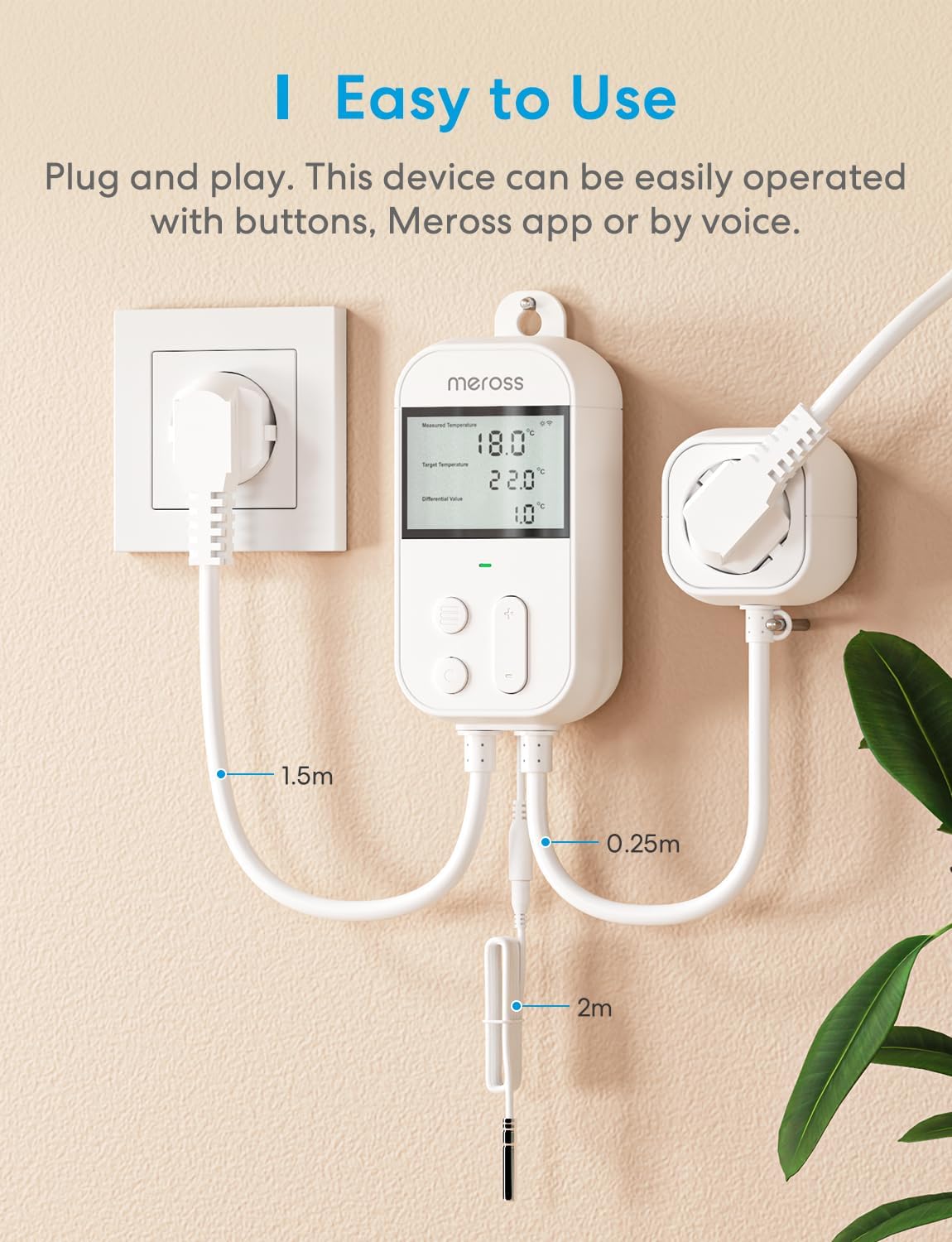
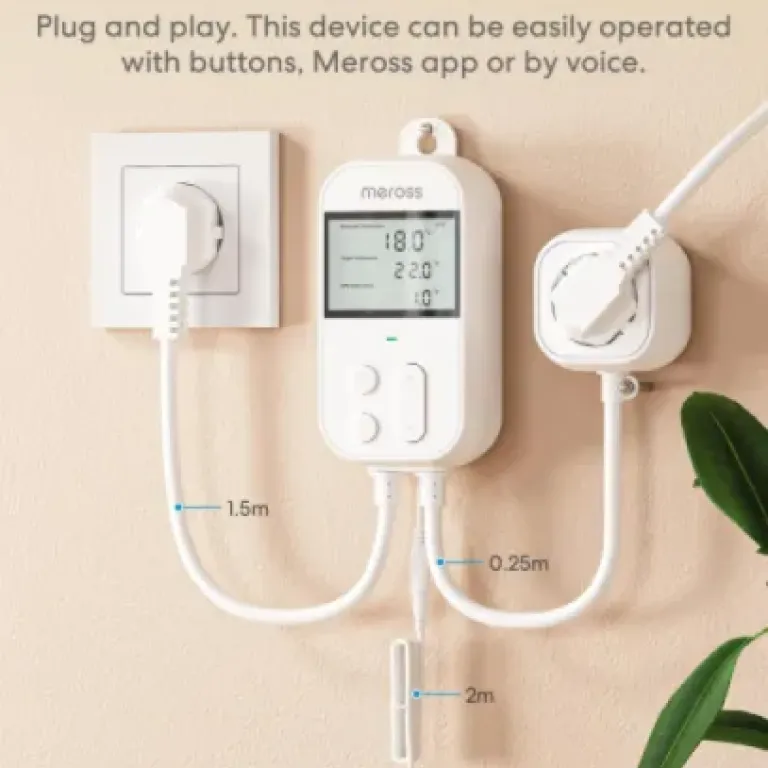
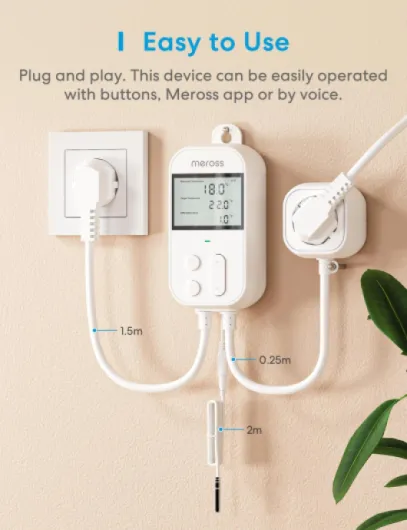
Design-wise, the Meross thermostat is pretty plain. It’s a white rectangular unit with a plug and socket plus a small screen. The finish is brushed plastic, not glossy. It feels more like something you’d happily leave in a garage, utility room, or behind a desk than a centrepiece on a designer wall. For my garden office, that’s fine; I’m not trying to impress anyone, I just want the temperature under control.
The good part is the screen is clear and the backlight is bright enough to read in low light. You can easily see both the current temperature and the target temperature at a glance. The buttons are simple: up/down and mode, nothing confusing. Even someone who never opens the app can walk up to it and figure it out in a minute. There’s also a button lock feature if you don’t want kids or guests messing with it.
The not‑so‑great side: the unit is a bit chunky and the short secondary cable (between the body and the controlled socket) can limit where you can place it. One reviewer mentioned they’d like that cable to be longer, and I agree. In my case, it ended up sort of hanging off a double socket, which doesn’t look amazing and makes positioning the screen less flexible. Also, the colour is more off‑white/greyish than pure white, so if you’re picky about matching it with bright white sockets or plates, you’ll notice the difference.
I also noticed that if you try to tuck it behind furniture, the screen becomes pointless, and you’re basically relying on the app. For a clean setup, you kind of want it visible, but then you have to accept that it looks like a functional gadget, not a pretty thermostat panel. Personally, I’m okay with that trade‑off, but if you’re planning to mount it in a freshly renovated living room and care a lot about aesthetics, it might annoy you.
Build quality and durability: solid enough, but not premium
Build quality feels decent but not fancy. The casing is ABS plastic with a brushed finish, which is typical for this kind of gear. It doesn’t creak when you press the buttons, and the plug/socket connection feels snug, not loose. The temperature probe is stainless steel and rated water‑resistant, and the cable feels thicker than the flimsy stuff you see on ultra‑cheap sensors, so I’m not worried it will fall apart after a few bends.
I’ve unplugged and replugged it quite a few times while testing different devices, and the unit hasn’t shown any weird behaviour. No random resets, no overheating, nothing like that. It’s rated up to 13A/2990W, and my 2 kW heater didn’t cause any issues even running for hours. The thermostat also has memory during power cuts, so when I flipped the breaker off to move some sockets and then turned it back on, it came back with the same settings and schedule. That’s important if you live in a place with occasional power blips.
One thing to keep in mind: this is still an all‑in‑one electronic device made in China, not an industrial controller. I wouldn’t expect it to survive harsh outdoor environments or being kicked around in a workshop. For normal indoor use – offices, bedrooms, lofts, cellars, greenhouses – it feels perfectly fine. Just don’t treat it like a rugged tool and you should be okay. The 2‑year manufacturer warranty is reassuring, but obviously you only find out how good that is if something breaks.
After a few weeks of daily use, I don’t see any red flags on durability. The screen backlight is still bright, the buttons respond well, and the sensor readings haven’t drifted compared to my separate thermometer. Long term, the main stress will be from running close to the 13A limit for hours; if you’re pushing it with a big heater, I’d make sure the plug and socket don’t get hot and that they’re in a well‑ventilated spot, just to be safe.
Performance: holds temperature well and doesn’t drop Wi‑Fi
In terms of pure performance, the Meross thermostat does the core job: it turns the heater on and off to keep the room roughly where you set it. I ran it with a 2 kW oil-filled radiator in a poorly insulated garden office. I set the target to 19°C during the day and 10°C at night. The thermostat claims ±0.5°C accuracy, and from what I saw compared to another thermometer on the desk, it was pretty close – usually within about 0.5–1°C. That’s good enough for comfort and miles better than the crude dial on the heater itself.
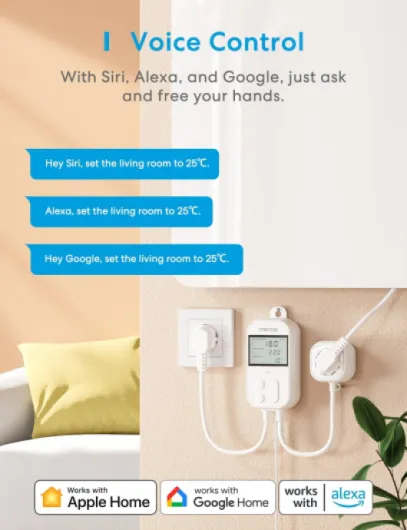
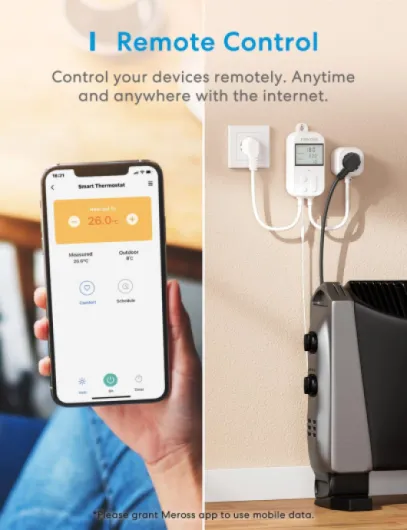
The Wi‑Fi connection was stable. Once I got it onto 2.4 GHz Wi‑Fi during setup, it stayed online. I didn’t see random dropouts or “device offline” messages in the app. Remote control from outside the house worked without any special tweaks – I could bump the temperature up from my phone before walking out to the office, and by the time I got there, the heater was already running. Voice commands through Alexa and Siri (via HomeKit) were also responsive; there’s maybe a one‑ or two‑second delay, which is normal.
I also tested the cooling mode with a small fan and a cheap drinks fridge just to see how it behaves. It flips the logic: in cooling mode, it powers the device when the temperature goes above the setpoint. For the fridge test, the compressor delay feature is important so it doesn’t rapidly cycle on and off and wreck the compressor. That feature worked as advertised – you can set a delay so it waits a bit before restarting. It’s not something I’d use daily, but it’s nice to know it’s there if I ever connect it to something more sensitive than a heater.
Overall, performance is strong for what it is. It doesn’t do anything fancy like learning your heating patterns or using weather data, but the basics – accurate temperature control, reliable Wi‑Fi, and quick response to commands – are solid. For a plug‑in thermostat in this price range, I’d say it’s more than decent. If you want super granular control or multi‑room logic, that’s out of scope for this device.
What this thermostat actually does (and what it doesn’t)
The Meross MTS960 is basically a Wi‑Fi thermostat built into a plug-style controller. You plug it into the wall, then plug your heater, fridge, fan, etc. into it. It has a separate stainless steel temperature probe on a 2 m cable, which is important because it means you control based on the air or water temperature where you place the probe, not just the temperature near the socket. It can handle up to 13A / 2990W at 240V, so it’s fine for most small heaters and similar appliances.
On the front you get a backlit LCD screen that shows the current temperature and the setpoint. There are physical buttons to change modes (heating or cooling), adjust temperature, and start timers. You don’t have to use the app all the time, which is good if someone in the house hates smartphones. The Wi‑Fi side hooks into the Meross app, and from there you can link it to Apple Home, Alexa, Google Home, and SmartThings. I had it running in HomeKit and Alexa at the same time with no real drama.
Feature‑wise, it’s pretty loaded for something in this price range. You get up to 12 schedules per day, high/low temperature alarms, sensor failure alarms, sensor calibration, compressor delay (useful if you’re controlling a fridge or AC), countdown timers, and cycle timers. There’s also energy monitoring, which logs how much power the connected device has used over time. You can download the history for free from the app, which is actually handy if you like to see how much that heater is costing you in winter.
What it doesn’t do: it doesn’t replace your main central heating thermostat in a nice wall-mounted way, and it doesn’t control a boiler directly. It’s really for plug‑in devices. Also, don’t expect fancy room presence detection or learning algorithms like high‑end thermostats. This is more of a straightforward on/off controller with smart features bolted on. For my use (controlling a single heater in an outbuilding), that’s exactly what I needed; for whole‑house heating, I’d look at something else.
Effectiveness in daily use: actually saves some effort (and probably some money)
Day to day, the thermostat mainly helps with two things: not having to think about the heater all the time, and not wasting as much energy. Before this, I’d either leave the heater running too long or come into a freezing office and crank it to max. Now, I’ve got a schedule: on at 7:30, off at 18:00, with the target temperature set to something reasonable. It just does its thing in the background. I only touch it if I’m working late or not working from the office that day.
The scheduling is flexible. You can set up to 12 temperature changes per day directly in the Meross app, and you can also tweak things via HomeKit or Alexa routines if you prefer. I liked the override behaviour: if I manually bump the temperature for a while, it goes back to the schedule after the time I’ve defined. One Amazon reviewer talked about using that in a bathroom with underfloor heating, and I get it – it’s nice to know it will switch off after an hour instead of you forgetting it on all day.
The energy monitoring isn’t perfectly precise like a dedicated energy meter, but it gives a decent idea of how much power the heater is using. After a week, I exported the data from the app and saw roughly how many kWh my office heater eats in a normal workweek. It’s “for reference only” as they say, but it’s enough to make you think twice about leaving it on when you’re not there. If you’re trying to cut bills, this info is actually useful, not just a gimmick.
So in practice, yes, it’s effective. My office stays roughly at the temperature I like without me fiddling with the dial every couple of hours, and I’m more aware of the power usage. It’s not going to magically slash your bills if your insulation is terrible, but it definitely helps avoid the classic “heater blasting for no reason” situation. For me, that’s already a win.
Pros
- Accurate enough temperature control with reliable Wi‑Fi and app integration
- Works with HomeKit, Alexa, Google, and SmartThings without subscriptions
- Flexible scheduling and override options that actually help save energy
Cons
- Chunky design with short cable makes placement awkward in some setups
- More functional than stylish – not ideal as a main living room thermostat
Conclusion
Editor's rating
The Meross WiFi Smart Thermostat plug is a practical bit of kit if you have a dumb heater, fridge, fan, or similar appliance that you want to control more precisely. It keeps temperature within a reasonable range of your setpoint, the Wi‑Fi connection is stable, and the app is straightforward. The fact that it works with Apple Home, Alexa, Google, and SmartThings is a big plus if you already live in that ecosystem. The scheduling, override options, and energy monitoring make day‑to‑day use easier and help you avoid wasting power for no reason.
It’s not perfect. The unit is a bit chunky, the short cable can limit placement, and the look is more “utility gadget” than stylish thermostat. If you’re trying to replace a nice wall thermostat in a main room, you’ll probably be annoyed by the aesthetics and the plug‑in format. But for a garden office, bathroom underfloor heating, cellar, greenhouse, or server corner, it gets the job done without too much fuss. If you want whole‑house smart heating, look elsewhere; if you just need to tame one or two appliances, this is a pretty solid and reasonably priced solution.